The Complete SaaS Journey: From First Problem to Compounding Revenue

Most SaaS companies do not have a growth problem. They have a lifecycle problem hiding in the handoffs between product, marketing, sales, growth, and customer success. Those gaps slow revenue even when every team is busy, and they are surprisingly common regardless of team size or funding stage.
The pattern usually looks like this. Product builds. Marketing waits for launch. Sales enters after the pricing page is ready. Growth inherits a funnel. Customer success inherits churn. Each team is doing its job, but each one enters too late. By the time a problem surfaces in the numbers, it has been baked into how the company operates for months.
Working harder inside each function rarely closes these gaps. The better move is to involve every function earlier and build a shared map of where the company is, what each stage requires, and what evidence proves the company is ready to move forward. That map is what I am sharing here.
The 11-stage lifecycle
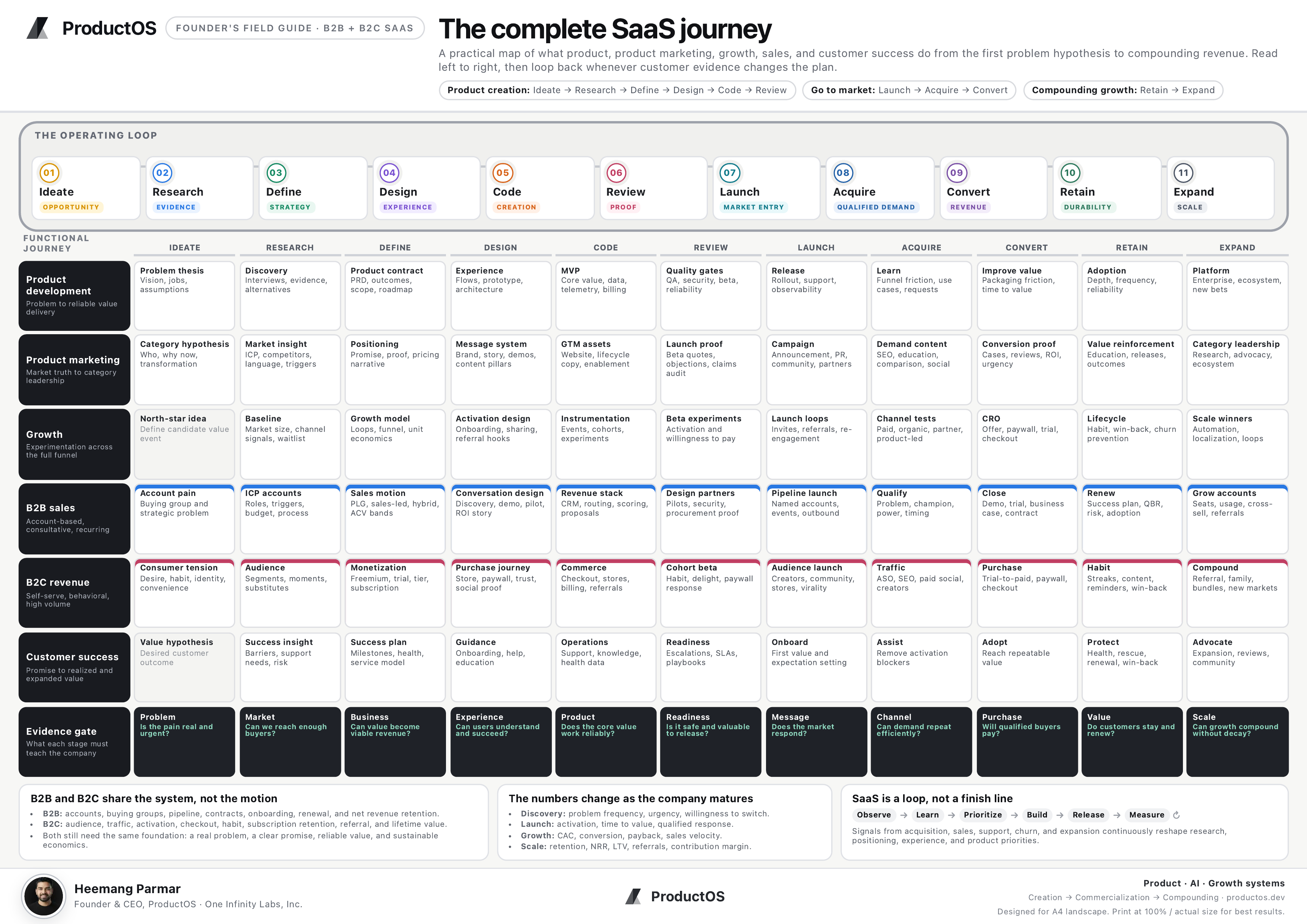
The SaaS journey runs through 11 stages, grouped into three phases. The first six are about creating something worth selling. The next three are about getting it to market. The final two are about making the revenue compound.
Ideate. Research. Define. Design. Code. Review. Launch. Acquire. Convert. Retain. Expand.
These are not project management milestones. They are evidence gates. Each one asks a specific question and requires a specific type of proof before the company should proceed. Skip the proof and the company ships something that is not ready, wastes budget on marketing that cannot convert, or burns out a sales team chasing deals that will not close.
Phase one: Creating something worth selling
The first six stages are a product development loop that transforms a problem hypothesis into a reliable, shippable product. This is where ProductOS lives by default when you build with ProductOS.
Ideate starts with finding a problem worth solving. Not a feature idea, not a technology looking for an application, but a specific, painful problem that a defined group of people encounters regularly and has to work around today. The evidence gate here is qualitative: have you talked to at least a handful of real people who have this problem and confirmed it is urgent enough to change behavior for? If you have not, you are still in the idea phase, not the product phase.
Research proves or disproves the market hypothesis. Who are the buyers? What alternatives do they use today? What does switching cost? Is there a window of urgency? Can you reach these buyers through repeatable channels? Research produces the market map that informs everything from pricing to sales motion. The evidence gate is quantitative where possible: market size estimates, channel signals, waitlist data. Qualitative interviews are the floor, not the ceiling.
Define is where the company commits. Ideal customer profile, value proposition, scope boundaries, pricing model, success metrics. This stage produces a product contract that the whole company can align on. The evidence gate is agreement: do product, marketing, and sales share the same picture of who the buyer is, what the product does, and what success looks like? Ambiguity here creates expensive confusion later.
Design shapes the experience and the market story in parallel. Product experience means user flows, key screens, and the architecture that makes those flows possible. Market story means the positioning, the demo narrative, and the content that teaches the market why this category matters. Design is not decoration. It is the translation layer between what the product does and what the buyer understands.
Code builds the product, the data layer, the billing system, and the go-to-market instrumentation. By the end of this stage, the product should be testable, the metrics should be measurable, and the sales team should have something to show. The evidence gate is functional: does the core value work reliably enough for a real user? Not feature-complete. Value-complete.
Review validates quality, usability, demand, and commercial readiness before launch. This includes QA, security review, usability testing, and a demand validation that confirms the market story resonates. The evidence gate is a go or no-go decision backed by evidence, not a calendar date.
Phase two: Getting to market
Launch, Acquire, and Convert are the go-to-market phase. They run concurrently with product iteration but have their own distinct jobs.
Launch coordinates the product release with the market-facing campaign. A product release without a campaign is a secret. A campaign without a product worth buying is noise. Launch produces the first real signal about whether the market responds to the message. The evidence gate is market response: does the coordinated release generate qualified attention, and does that attention convert into trial or demo requests?
Acquire builds repeatable demand through channels that the company can scale. This includes paid acquisition, organic content, partner channels, and product-led growth loops. The evidence gate is channel efficiency: can the company acquire a qualified customer at a cost that the unit economics support? Early-stage companies tolerate inefficiency if they are learning. Growth-stage companies need efficiency or the model breaks.
Convert turns qualified demand into paying customers. For B2B, this means a sales process. For B2C, this means a product-led funnel. The evidence gate is willingness to pay: will the qualified buyers sign a contract or enter a paid subscription? If they will not pay, the question is why, and that answer belongs in the earlier stages, not here.
Phase three: Making revenue compound
Retain and Expand are where SaaS economics are made or broken. A company that grows by adding new customers but loses equal revenue to churn is running to stay in place.
Retain delivers repeatable value that keeps customers paying. The work starts in onboarding and continues through every interaction the customer has with the product and the company. The evidence gate is renewal intent: are customers approaching renewal with clear value realization and willingness to continue? If not, the problem started at acquisition or onboarding, not at renewal.
Expand grows accounts, usage, and revenue through seats, upgrades, new use cases, and referrals. This is where net revenue retention above 100% can come from. The evidence gate is expansion rate: is the value customers receive creating a credible path to more usage or a broader relationship?
The two commercial routes
The lifecycle is shared, but the commercial path differs significantly between B2B and B2C. Understanding which route you are on determines how sales, marketing, and customer success operate.
B2B SaaS moves through accounts, buying groups, pipeline, contracts, adoption, renewal, and expansion. The buying process involves multiple stakeholders, budget cycles, and risk aversion. The sales motion needs to map to how buying groups actually decide, not how founders wish they decided. B2B growth is built on net revenue retention: renewals and expansions compounding on top of new logo revenue.
B2C SaaS moves through audience, traffic, activation, checkout, habit, retention, and referral. The purchase decision is individual, the volume is higher, and the economics depend on lifetime value relative to acquisition cost. B2C growth is built on product-led loops: the product creates its own demand through viral mechanics, content, and referral incentives.
Both routes still depend on the same foundation: a real problem, a clear promise, reliable value, and sustainable unit economics. The route shapes the motion. The foundation determines whether the motion is viable.
The six functional journeys
Across these 11 stages, six functions are working in parallel, each with their own vocabulary and metrics. The visual map shows how each function contributes at each stage.
Product development owns the problem-to-reliable-value chain: the product contract, the build, the quality gates, and the release. Product marketing owns the market truth-to-category-leadership chain: the positioning, the message system, the GTM assets, and the demand generation content. Growth owns the full-funnel experimentation chain: the north-star metric, the activation design, the channel tests, and the lifecycle programs.
B2B sales owns the account-based, consultative chain: the ICP accounts, the sales motion, the revenue stack, and the renewal motion. B2C revenue owns the self-serve, high-volume chain: the audience, the monetization model, the commerce infrastructure, and the habit loop. Customer success owns the promise-to-realized-value chain: the success plan, the onboarding, the health monitoring, and the advocacy program.
The evidence gates row in the visual captures the question each stage must answer for the company. These are not rhetorical questions. They are the decisions that determine whether the company moves resources forward or holds them. Treating every stage as equally important is how companies end up with expensive products that do not sell.
Stage metrics that matter
The numbers change as the company matures. Early-stage companies optimize for learning and signal. Growth-stage companies optimize for efficiency and compounding.
In discovery stages, the relevant metrics are problem frequency, urgency, and willingness to switch. In launch stages, activation rate and time to first value take priority. In growth stages, CAC, conversion rate, payback period, and sales velocity become the operating metrics. In scale stages, retention rate, net revenue retention, LTV, referral rate, and contribution margin determine whether the company is compounding or plateauing.
Tracking the right metrics for the current stage prevents two failure modes. One is measuring vanity metrics before the company has proven product-market fit. The other is ignoring retention and expansion signals once the company has moved past initial traction.
Why lifecycle handoffs cause most growth problems
When a company hits a growth wall, the instinct is to blame the current bottleneck. Sales says there are not enough leads. Marketing says the product is not ready. Product says sales does not know how to position. Customer success says the onboarding is broken. Everyone is right, and everyone is describing a symptom, not the cause.
The cause is almost always a lifecycle handoff problem. Product marketing starts during customer research, not two weeks before launch. Growth starts when you design onboarding, activation, instrumentation, and referral loops, not when you start running ads. Sales shapes the ICP, positioning, packaging, and buying journey before the product is fully built. Retention starts with the first promise made to the customer, not when the churn dashboard turns red.
More process alone will not solve this. Teams need a shared map that every function can read, plus explicit accountability at the transitions between stages. The 11-stage map works as a diagnostic. When growth stalls, ask which stage moved forward without enough evidence and what the team needs to learn now.
How to use this map
Print it. Put it somewhere the team can see it. Use it in planning sessions to ask which stage the company is in, what evidence it has, and what would change the answer.
The map is not a to-do list. It is a forcing function for honest conversation about where the company actually is versus where it wishes it was. The most expensive mistake in early-stage SaaS is treating every stage as done when it is only half-complete, and then being surprised when the downstream stages require revisiting the earlier work anyway.
ProductOS works through these stages as connected, iterative cycles, with context flowing forward from research through build to launch and beyond. But the underlying logic applies regardless of what tools a team uses. A shared map of the lifecycle turns individual function excellence into company-wide compounding.
Download the visual
The full one-page visual maps all 11 stages across all six functional journeys, with the evidence gates, the B2B and B2C routes, and the stage metrics. It is designed for A4 landscape and should be printed at actual size for best readability.
Download the print-ready PDF (A4 landscape)
Frequently asked questions
What are the 11 stages of the SaaS lifecycle?
Ideate, Research, Define, Design, Code, Review, Launch, Acquire, Convert, Retain, and Expand. These cover the full arc from problem hypothesis to compounding revenue. Ideate through Review are the product creation phase. Launch through Convert are the go-to-market phase. Retain and Expand are the compounding phase.
What is the difference between B2B and B2C SaaS go-to-market?
B2B SaaS moves through accounts, buying groups, pipeline, contracts, adoption, renewal, and expansion. The process is consultative, account-based, and depends on net revenue retention. B2C SaaS moves through audience, traffic, activation, checkout, habit, retention, and referral. The process is self-serve, volume-based, and depends on lifetime value relative to acquisition cost. Both share the same 11-stage lifecycle but execute differently at each stage.
What are SaaS evidence gates?
Evidence gates are the specific questions each stage must answer before a company proceeds to the next stage. For example: Is the pain real and urgent? Can we reach enough buyers? Can value become viable revenue? Can users understand and succeed? Does the core value work reliably? These gates prevent companies from skipping ahead and discovering they have a fundamental problem two stages too late.
What metrics matter at each SaaS stage?
In discovery: problem frequency, urgency, and willingness to switch. In launch: activation rate and time to first value. In growth: CAC, conversion rate, payback period, and sales velocity. In scale: retention rate, NRR, LTV, referral rate, and contribution margin. Measuring the wrong metrics for the current stage is a common mistake that wastes energy on vanity numbers instead of the signals that actually move the company forward.
Why do most SaaS companies have lifecycle handoff problems?
Because functions optimize for their own metrics rather than the company’s. Product builds and hands off to marketing. Marketing waits for the product. Sales enters late with no input on positioning or packaging. Customer success inherits churn that was baked in at onboarding. The fix is not to add process. It is to involve every function in the stages before their involvement traditionally starts, and to use the evidence gates as forcing functions for honest cross-functional conversation.
What comes after the SaaS launch stage?
Launch is followed by Acquire, which builds repeatable demand through channels that scale. Acquire is followed by Convert, which turns qualified demand into paying customers. These three stages run concurrently with ongoing product iteration. The final two stages, Retain and Expand, are where SaaS economics are made or broken through renewal and expansion revenue.
How does ProductOS handle these stages?
ProductOS runs the first six stages (Ideate through Review) as connected, iterative cycles in the Build product, with specialized agents for research, definition, design, code, and review. The go-to-market and compounding stages are supported through how ProductOS works and the broader platform. The 11-stage map is embedded in how the product operates, so teams do not have to hold it all in their heads.
The ProductOS blog publishes practical guides for founders and product teams working through each stage of the SaaS lifecycle.
CS engineer and IIM Lucknow MBA. Built products across enterprise and AI for 10+ years. Founded ProductOS to give every PM and founder the leverage of a full product team. Writes about AI product development, PRDs, and building with agents.