What is agentic product development? How AI agents build products

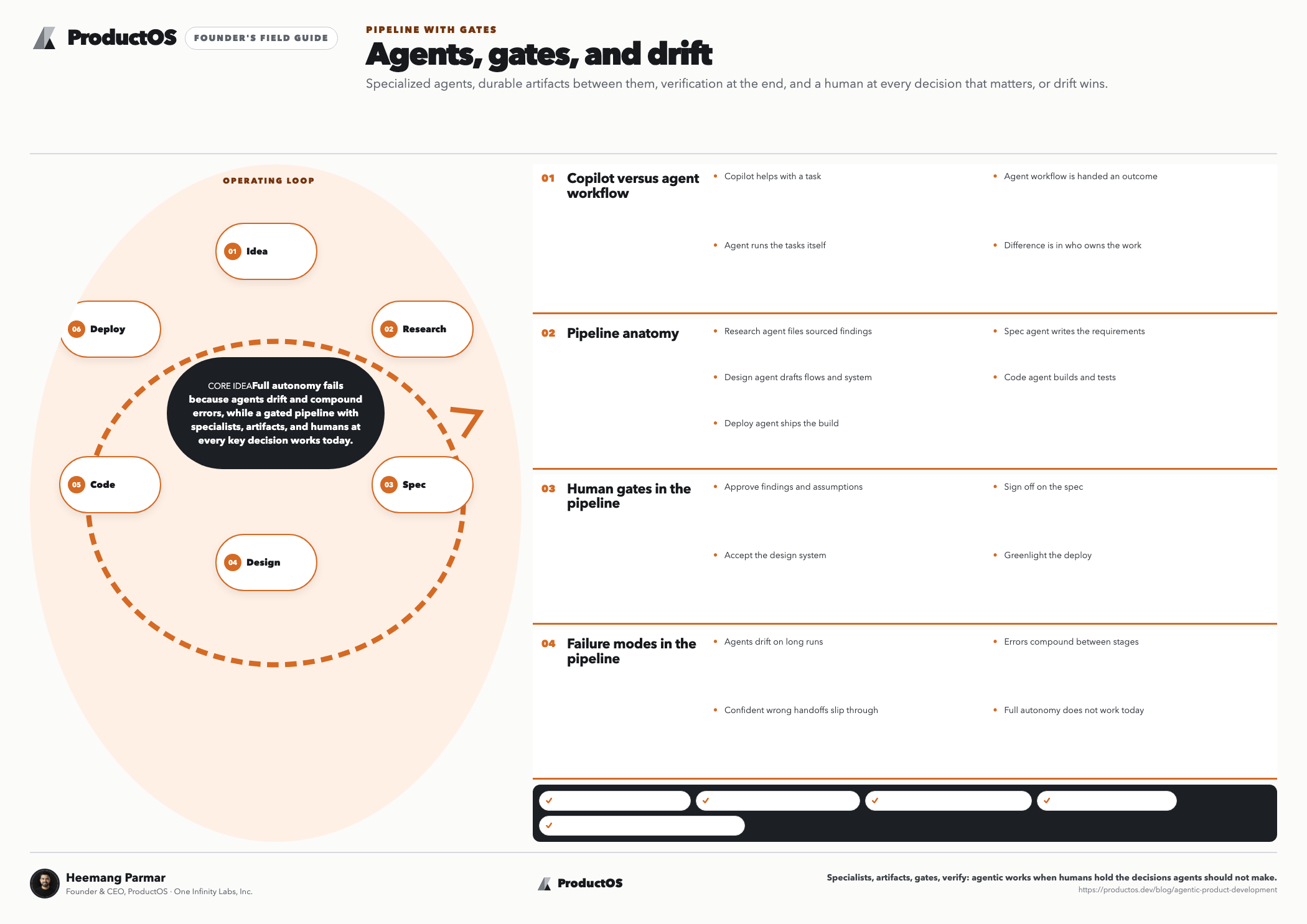
Agentic product development is the practice of running the product lifecycle, from idea through research, spec, design, code, and deployment, as an AI agent workflow: multiple specialized agents doing the work, one shared project context connecting them, and humans approving at defined gates. It is the step past copilots. A copilot helps you do a task; an agent workflow is handed an outcome and runs the tasks itself.
This shift is the most consequential change in how products get built since cloud infrastructure, and it is also widely oversold. Full autonomy does not work today. Agents drift, compound each other’s errors, and confidently ship the wrong thing when nobody checks the handoffs. What works is a pipeline: specialized agents, durable artifacts between them, verification at the end, and a human at every decision that matters.
Here is the moment that makes it concrete. On Monday you hand a workflow one line: a scheduling tool for tutors. By Wednesday there are sourced findings on the market, a spec outline waiting for your approval, and three open questions only you can answer. You spent those two days on your actual job. That change in what a week feels like is the subject of this guide.
I run a company built on exactly this architecture, so this guide is written from the operator’s side: what an agent workflow actually is, why specialists beat one general agent, where humans belong, and the failure modes nobody puts in the launch video. To see a working pipeline before reading about one, see how the five-stage pipeline works.
What is agentic product development?
Agentic product development means AI agents own stages of product work end to end, rather than assisting a human who owns everything. An agent researches the market and files sourced findings. Another writes the spec. Another builds the code. Humans set direction and approve outputs at gates instead of performing every step.
The distinction from ordinary AI assistance is about who holds the loop. With a chatbot or copilot, you hold the loop: you ask, it answers, you integrate the answer, you decide what happens next, forty times a day.
In an agentic workflow, the agent holds the loop for its stage. It plans the steps, uses tools, checks its own output, and comes back when the stage deliverable is ready or when it needs a decision only you can make.
The capability shift behind this is measurable. On SWE-bench, the benchmark that has agents resolve real GitHub issues, top systems went from resolving low single-digit percentages of issues at its 2023 debut to well over half by 2025. That is the difference between a party trick and a coworker. The same jump happened quietly in research, writing, and design tasks.
What did not change is the failure cost of ambiguity. Hand an agent a vague outcome and it delivers a confident, complete, wrong result. Agentic development therefore rises or falls on the quality of the artifacts between agents: the brief, the findings, the spec. This is also what separates it from vibe coding, where the only artifact is a chat transcript that evaporates.
What is an AI agent workflow?
An AI agent workflow is a structured sequence in which agents receive a goal, perform multi-step work with tools, and pass verified outputs downstream. Five components make one work: specialized agents, an orchestration layer, shared context, tool access, and human approval gates. Remove any one and the workflow degrades fast.
It is worth separating the components, because most “agent workflow” diagrams blur them:
- Specialized agents. Each agent has one job, one system prompt tuned for that job, and only the tools that job needs. A research agent gets web search and citation tools; a coding agent gets a sandbox and a terminal.
- Orchestration. Something decides which agent runs when, what it receives, and what happens on failure. In ProductOS this is a dedicated Orchestrator agent; in home-built setups it is often a human with a checklist, which also works.
- Shared context. The project memory every agent reads: the concept, the research findings, the spec, the design tokens. Without it, each agent starts from zero and the workflow re-explains itself at every step, usually badly, because models forget what falls outside the context window. Keeping the right information in front of each agent is its own craft, covered in context engineering.
- Tools. Agents earn the name by acting: searching, writing files, running code, calling APIs. An agent without tools is a chatbot with ambitions.
- Human gates. Defined points where a person approves, redirects, or rejects before work continues downstream.
Notice that only one of the five components is about model intelligence. The rest is systems design, which is why agent workflows reward product and engineering discipline over prompt tricks, and why the teams doing this well look suspiciously like teams that were already good at process.
Why use specialized agents instead of one general agent?
Specialists beat a generalist for the same reason job descriptions exist: focus. A single agent doing research, spec writing, design, and coding carries every instruction at once, and quality drops as the prompt fights itself. Specialized agents get narrow instructions, narrow tools, the right model for the job, and outputs you can verify independently.
Three concrete advantages show up in practice:
- Focused prompts outperform kitchen-sink prompts. An agent whose entire instruction set is about writing requirements documents writes better requirements than an agent juggling ten roles. Anthropic’s published write-up on its own multi-agent research system reported the same pattern: multiple coordinated agents beat a single agent on complex, breadth-heavy tasks, at the cost of more tokens.
- Model routing per task. Research rewards a model with strong retrieval and citation behavior. Coding rewards a model that tops the coding benchmarks. Ideation can run something cheaper and more exploratory. A single-agent architecture forces one model to be all of these; a specialist architecture lets you route each job to the model that wins it.
- Verifiable handoffs. When the research agent’s output is a findings document, you can check it before the spec gets written. When one agent does everything internally, errors travel silently from step to step and surface as a broken product at the end.
The honest counterpoint: specialization adds coordination cost, and for small tasks it is overkill. If the job is “build me a landing page,” one good coding agent is the right architecture and a ten-agent pipeline is theater. Specialists earn their overhead when the work has genuinely different phases, which is exactly what product development is: research is not spec writing, spec writing is not design, and design is not deployment.
How does an agent pipeline take a product from idea to production?
A full pipeline runs five stages. Ideation sharpens the concept, discovery validates it with sourced research, definition turns it into a spec, design produces flows and a design system, and development builds, tests, and deploys. Each stage has dedicated agents, and each stage’s output becomes the next stage’s input.
Here is the pipeline as ProductOS runs it, stage by stage:
| Stage | Agents | What comes out |
|---|---|---|
| Ideate | Ideation agent, a Socratic questioner | A concept brief, an assumptions log, an open-questions list |
| Discover | Research agent | Sourced findings, a competitor registry, validation surveys |
| Define | PRD agent, plus an optional Architect agent | A sectioned PRD with user stories and success metrics; optionally architecture and cost estimates |
| Design | Design agent and Design System agent | User flows, screen specs, and a token-based design system with dark and light previews |
| Develop | Fullstack Builder, QA agent, Deploy agent | A production codebase in your GitHub, a QA verdict, a live deployment on your domain |
Two details make this a pipeline rather than five disconnected tools. First, the Orchestrator agent sits across all five stages, routing work and carrying state, so you never re-explain the project.
Second, every stage reads the artifacts of the stages before it. The spec is grounded in the actual research findings, not in what a model imagines the market looks like. The code is built on the exact design tokens the design stage produced, not a fresh interpretation of “make it look clean.”
The compounding effect is the point. Each artifact makes every downstream agent smarter, which is the structural answer to the context-loss problem that kills long chat-based builds. The Define stage is the hinge of the whole thing: everything before it produces evidence, everything after it consumes the spec, and the AI PRD generator exists to make that hinge strong. The discipline of writing specs agents can execute has a full guide of its own in spec-driven development.
What does one build look like in practice?
Walk a hypothetical through it: a booking tool for photography studios. Ideation pushes back on the raw idea and surfaces the assumption that studios double-book because their calendar and their invoicing live in different tools. Discovery pressure-tests that against real complaints in competitor reviews and returns the evidence, linked.
Define turns the evidence into a spec: scope, a dozen user stories, and a success metric of zero double-bookings. Design produces the flows and a token system. Develop builds against those tokens in a sandbox, QA drives the signup and booking flows in a real browser, and Deploy pushes the code to the owner’s GitHub.
Total elapsed time is days, and the person running it made five decisions: the concept, the spec outline, the design direction, the QA verdict, and the deploy. Everything else was labor the pipeline carried.
Where do humans belong in an agentic workflow?
Humans belong at the decisions that are expensive to reverse: what to build, what the spec commits to, what the product looks like, and whether it ships. Agents do the labor between those decisions. A workflow with no human gates is not autonomous, it is unsupervised, and unsupervised agents compound errors at machine speed.
The practical design question is gate placement. Too many gates and you have rebuilt the meeting culture agents were supposed to replace; too few and you discover problems in production. The placement rule I trust: gate the irreversible, automate the redoable.
- Gate the concept. A wrong direction poisons every downstream stage, so the sharpened concept deserves explicit sign-off.
- Gate the spec outline. In ProductOS the PRD is written section by section only after you approve the outline, because approving structure is fast and correcting a finished forty-page document is not.
- Gate the design direction. Brand and design tokens get locked by a human before code is generated on top of them.
- Automate the build, verify the result. Watching an agent write code adds nothing. Reading a QA verdict with screenshots before shipping adds everything.
- Gate the deploy. Production is a human decision for anything with users.
What changes for the people at these gates is the shape of their day. Founders and PMs stop being couriers between functions and start being editors of artifacts: reviewing findings, redlining specs, rejecting screens. Judgment stays; throughput multiplies. The role shift runs deeper than one article can carry, and the companion piece on AI-native product development covers what it does to teams.
Tips
- Write the goal as an outcome with a definition of done, not as a list of steps.
- Gate the irreversible decisions and automate the redoable ones; review artifacts, not transcripts.
- Require a source on every factual claim an agent hands downstream, so errors are catchable at the gate.
- Never let the agent that built something be the agent that verifies it.
- Set a token budget per stage before the pipeline runs, not after the invoice arrives.
What breaks in agentic workflows, and how do you prevent it?
Four failure modes account for most agentic disasters: context loss between agents, error compounding across handoffs, unverified output shipping as fact, and runaway cost. All four are architecture problems with architecture answers, which is good news, because it means prevention is a design decision rather than a wait for better models.
| Failure mode | What it looks like | The fix |
|---|---|---|
| Context loss | The build agent contradicts the spec; the design ignores the research | One shared project context every agent reads; durable artifacts, not chat history |
| Error compounding | A wrong research claim becomes a wrong spec becomes a wrong product | Human gates between stages; sources attached to claims so they can be checked |
| Unverified output | The agent reports success; the signup flow is broken | Independent verification, ideally in a real browser, by an agent that did not write the code |
| Runaway cost | Token spend grows faster than output quality | Model routing per agent; small models for small jobs; caps and monitoring |
The third row is the one I would tattoo on the industry. An agent grading its own work is a conflict of interest, the same as it is with people. The verifier has to be separate from the builder and has to test the artifact, not the transcript.
In our pipeline that means the QA agent drives the actual app in real headless Chromium and returns a pass, partial, or fail verdict with severity-ranked findings, and a fail can chain straight into an automated fix run. The number of “done” builds that come back partial is the strongest argument for the architecture.
The cost row deserves one honest sentence too: agent workflows consume more tokens than single-model chats, full stop. Multi-agent systems trade compute for quality and throughput. For product development, where the alternative is weeks of human time, the trade is overwhelmingly worth it, but pretending the meter does not run is how teams get surprised.
How does ProductOS run agentic product development?
ProductOS is a working implementation of everything above: ten specialized agents (Orchestrator, Ideation, Research, PRD, Architect, Design, Design System, Fullstack Builder, QA, Deploy) sharing one project context across the Ideate, Discover, Define, Design, and Develop stages.
The gates are real. Research cites its sources. The PRD is written section by section behind an outline approval gate. The build runs in an isolated cloud sandbox with a live preview.
The QA agent verifies in real headless Chromium with a pass, partial, or fail verdict, and the Deploy agent preflights the build, pushes to your own GitHub, and self-fixes up to three times. Model routing is BYOK and multi-provider, with no model hardcoded anywhere in the pipeline.
The output is not demos. SOLEN, Orbit, StudioFlow, Lumen Notes, Echo, and Reserva all shipped through this pipeline and run in the wild. Every agent has its own page if you want the specifics: meet the ten agents.
Frequently asked questions
What is the difference between an AI agent and an AI workflow?
An AI agent is a single system that pursues a goal with tools: it plans, acts, observes, and adjusts. An AI agent workflow is the larger structure that connects multiple agents: who runs when, what context they share, and where humans approve. One agent can be excellent alone; a workflow is what you need when the job has distinct phases with handoffs between them.
Can AI agents build an entire product end to end?
Yes, with humans at the gates. Agent pipelines today can take a product from raw idea through research, spec, design, working code, browser-verified testing, and deployment. What they cannot do reliably is make the judgment calls: which idea to pursue, which scope to cut, whether the design fits the brand. Fully autonomous end-to-end building without human review produces confident, polished, wrong products.
How many AI agents does it take to build a product?
There is no magic number; there is a matching principle. Each genuinely distinct phase of work deserves its own agent, because focused instructions beat blended ones. Product development decomposes naturally into ideation, research, requirements, architecture, design, coding, QA, and deployment, which is why ProductOS runs ten. A weekend prototype needs one. Counting agents matters less than whether handoffs between them are verified.
Do agentic workflows need different models for different agents?
Not strictly, but routing helps. Coding agents benefit from models that lead coding benchmarks, research agents from models with strong retrieval and citation behavior, and lightweight steps can run cheaper models to control cost. The architecture matters more than any single choice: a workflow with no model hardcoded can adopt each new frontier model the week it ships, per agent, without a rebuild.
What is human-in-the-loop in agentic development?
Human-in-the-loop means people approve or redirect agent output at defined checkpoints instead of supervising every step or none. In product pipelines the loop sits at the irreversible decisions: concept sign-off, spec outline approval, design lock, and the deploy decision. Done well, it converts the human role from performing work to editing it, which is where human judgment pays the highest return per hour.
How is an agent pipeline different from automation tools like Zapier or n8n?
Automation tools execute predefined steps: when X happens, do Y, identically every time. Agent pipelines handle open-ended work where the steps are not knowable in advance: researching a market, writing a spec, debugging a build. The agent decides its next action from the current state. Automation is deterministic and cheap; agents are adaptive and verifiable. Mature stacks use both, with automation wiring the plumbing between agent stages.
Which agents run the ProductOS pipeline?
Ten specialists: the Orchestrator routes work across the pipeline, Ideation sharpens the concept, Research validates it with cited findings, PRD writes the spec behind an outline gate, Architect covers system design when the build warrants it, Design and Design System produce flows and tokens, the Fullstack Builder codes in a live sandbox, QA verifies in real Chromium, and Deploy ships to your GitHub and domain.
Where should you go from here?
Agentic product development is not a prediction anymore; it is an operating model with shipped products behind it. The teams that win with it will be the ones that treat it as systems design: specialists, shared context, verified handoffs, and humans at the gates. Start by seeing what each specialist actually does: meet the agents behind the pipeline, then run your own idea through the stages free.
CS engineer and IIM Lucknow MBA. Built products across enterprise and AI for 10+ years. Founded ProductOS to give every PM and founder the leverage of a full product team. Writes about AI product development, PRDs, and building with agents.