What is a product requirements document (PRD)? The complete guide

A product requirements document (PRD) is the single document that defines what a product or feature must do, who it is for, and how the team will know it worked. It covers the problem, the target user, the functional requirements, the scope boundaries, and the success metrics, so engineering and design can build without guessing. A PRD records decisions, not wishes: every line in it should be something the team has actually agreed to build.
The document earns its keep in a moment every product person recognizes. You describe a feature in a kickoff call, everyone nods, and five weeks later the demo shows something nobody asked for. The gap was never effort; it was that each person built the version in their own head. A PRD exists so there is only one version.
This guide covers the full anatomy of a PRD: every section and what belongs in it, the difference between a good and a bad requirement line, the main template formats, how a PRD relates to a BRD or a tech spec, and the writing process step by step. It also covers what AI changes, because in 2026 the first draft of most PRDs is generated, not typed from scratch.
If you would rather learn by doing, the free AI PRD generator drafts a structured document from a short product description in a few minutes, and you can follow along with your own idea.
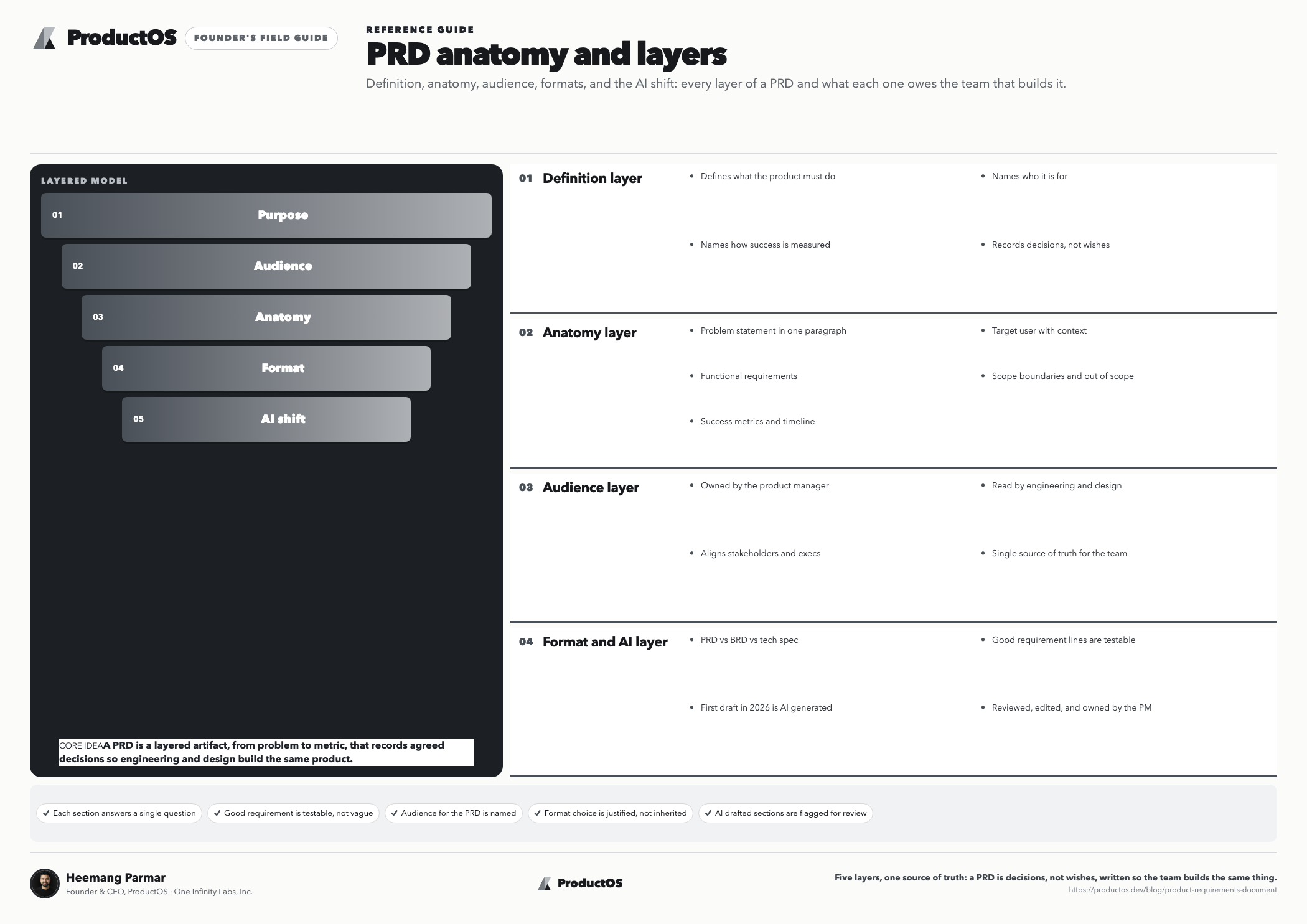
What is a product requirements document?
A product requirements document is a written specification that describes the purpose, features, behavior, and success criteria of a product before it is built. It answers three questions: what problem are we solving, what exactly must the product do, and how will we measure whether it worked. It is owned by the product manager and read by everyone else.
The key word is requirements. A PRD does not describe how the product will be implemented; that belongs to engineering in an architecture or technical design document. It describes what the product must do from the user’s side, precisely enough that a designer, an engineer, or an AI agent could build against it and a tester could verify the result. The PRD glossary entry has the short version if you need a definition to share.
A useful mental test: if two reasonable people can read a line in your PRD and picture two different products, the line is not a requirement yet. It is an intention. The whole craft of PRD writing is converting intentions into statements specific enough to build and test.
Why does a PRD still matter in 2026?
A PRD matters more now, not less, because AI moved the bottleneck. Code generation is fast and cheap; deciding what to build is still slow and expensive. When an AI agent can produce a working app from a document in hours, the quality of that document becomes the quality ceiling of the product.
For a decade, agile culture treated heavyweight documents with suspicion, and often rightly: a 40-page spec nobody read was waste. But the alternative most teams landed on, a pile of loosely written tickets, worked only because human engineers filled the gaps with judgment and hallway conversations.
AI builders do not attend hallway conversations. They build exactly what the document says, including its ambiguities.
That is why spec-driven development has emerged as the counterweight to prompt-and-pray building: the spec, usually a PRD, becomes the durable source of truth that generation runs against. Teams that write precise requirements get compounding returns, because the same document drives design, build, QA, and the next iteration.
What sections does a PRD include?
A complete PRD includes a problem statement, goals and non-goals, target users, user stories, functional requirements, non-functional requirements, success metrics, scope and constraints, dependencies and risks, and open questions. Not every product needs every section at full depth, but every section answers a question someone on the team will otherwise ask you in review.
| Section | The question it answers | Most common failure |
|---|---|---|
| Problem statement | What user pain are we solving, and what evidence do we have? | Describes the solution instead of the problem |
| Goals and non-goals | What does success mean, and what are we explicitly not building? | Non-goals section missing entirely |
| Target users | Who is this for, specifically? | “Everyone” or a persona nobody validated |
| User stories | What are the core flows from the user’s perspective? | Stories that restate features instead of outcomes |
| Functional requirements | What exactly must the product do? | Vague, untestable statements |
| Non-functional requirements | How fast, secure, accessible, and reliable must it be? | Omitted, then discovered in production |
| Success metrics | How will we know it worked? | Vanity metrics with no target or timeframe |
| Scope and constraints | What are the technical, legal, and timeline boundaries? | Constraints known to engineering but never written down |
| Dependencies and risks | What could block or break this? | Third-party dependencies discovered mid-build |
| Open questions | What is still undecided, and who owns the decision? | Pretending there are none |
Two sections deserve extra attention. Non-goals are the cheapest scope control you will ever write: one line here saves a week of debate later.
Success metrics should trace back to the problem statement; if the problem is onboarding drop-off, the metric is activation, not sign-ups. If you have not yet defined the one metric your product moves, the north star metric finder is a fast way to pressure-test candidates before you commit one to the PRD.
For user stories, keep the standard format (as a user, I want, so that) but hold each story to the same testability bar as a requirement. The free user story generator produces them in a consistent format with acceptance criteria attached, which is most of the battle.
What does a good requirement line look like?
A good requirement line is specific, testable, and describes one behavior. Someone who was not in the meeting can read it and know exactly what to build, and a tester can verify it with a clear pass or fail. Most weak requirements fail on one of those three properties.
The fastest way to internalize the standard is to see weak and strong versions side by side:
| Weak requirement | Strong requirement | What changed |
|---|---|---|
| The app should load fast | Search results render within 500 ms at the 95th percentile on a mid-range mobile device over 4G | A number, a percentile, and a device context replace an adjective |
| Users can log in easily | Users can sign in with email and password or Google OAuth; a failed attempt shows the specific reason and allows immediate retry | Names the methods and defines the failure path |
| Support notifications | Send a confirmation email within 60 seconds of a completed booking; the user can disable booking emails in settings | Specifies the trigger, the deadline, and the user control |
| The dashboard should be intuitive | A first-time user can create their first project without opening documentation, verified in onboarding analytics | Replaces an opinion with an observable, measurable behavior |
| Handle errors gracefully | If a payment fails, show the decline reason, preserve the cart state, and offer retry with a different payment method | Defines the exact behavior for a named failure case |
Three rules generate most of these improvements:
- One behavior per line, numbered. Reviews and tests can then reference REQ-12 instead of “that part about payments.”
- Ban unverifiable adjectives. Fast, easy, intuitive, robust, and simple are opinions until you attach a measurement.
- Write the unhappy path. Every requirement that accepts input needs a sibling requirement for what happens when the input is wrong, the network fails, or the user abandons midway.
Weak PRDs describe the demo; strong PRDs describe the product.
What PRD formats and templates should you use?
There is no single correct PRD format; there is a correct format for each situation. A one-page PRD suits small features and early validation. A full PRD suits new products and anything with compliance or platform risk. Amazon’s press-release format suits zero-to-one bets. AI-ready specs suit anything an agent will build.
| Format | Best for | Typical length | Watch out for |
|---|---|---|---|
| One-page PRD | Single features, fast-moving teams, early drafts | 1 page | Compression becoming vagueness |
| Full PRD | New products, regulated domains, multi-team builds | 4 to 10 pages | Length used as a substitute for decisions |
| Press release and FAQ (working backwards) | Zero-to-one products where the customer story is the risk | 1 to 2 pages plus FAQ | Great narrative, missing requirement detail |
| Lean or agile epic brief | Iterative teams working in epics and stories | 1 to 2 pages per epic | Context scattered across tickets over time |
| AI-ready spec | Products built partly or fully by AI agents | 2 to 6 pages, structured | Ambiguity, which agents cannot resolve by asking around |
The press-release format deserves a note because it is the most misunderstood. Amazon’s working-backwards process starts from a hypothetical launch press release and FAQ, which is excellent for forcing customer clarity. It is not a substitute for requirements; Amazon teams still write detailed specs behind the narrative. Use it as the front page of a PRD, not the whole document.
The AI-ready spec is the newest format and the least documented. The difference is discipline, not new sections: everything implicit must become explicit, because an AI builder will not ask the follow-up question a senior engineer would. Structured headings, numbered requirements, named non-goals, and explicit error behavior all matter more. Browse the template library for structures you can start from rather than assembling one from scratch.
How is a PRD different from a BRD, MRD, or tech spec?
The documents differ by question and by audience. An MRD argues there is a market. A BRD argues the business should invest. A PRD defines what the product must do. A tech spec defines how engineering will build it. In most modern teams the MRD and BRD collapse into a discovery brief, and the PRD carries the weight.
| Document | Core question | Owner | Primary audience |
|---|---|---|---|
| MRD (market requirements) | Is there a market worth entering? | Product marketing | Leadership |
| BRD (business requirements) | Why should the business invest? | Business stakeholder | Executives, finance |
| PRD (product requirements) | What must the product do? | Product manager | Engineering, design, QA |
| Tech spec / design doc | How will we build it? | Engineering | Engineers |
The practical boundary to police is PRD versus tech spec. When a PRD starts naming database tables and framework choices, it has crossed into engineering’s territory and will age badly. State the constraint if it is real (must integrate with the existing auth system) and leave the implementation to the people and agents doing it.
How do you write a PRD, step by step?
Writing a PRD is a decision process with a document at the end, not a writing exercise. The sequence below front-loads the thinking so the writing is fast. It works whether you type every word yourself or generate the draft with AI; only the speed of the middle steps changes.
- Gather the evidence first. Collect user feedback, support tickets, research notes, competitor observations, and known technical constraints. A PRD built on evidence survives review; a PRD built on opinion restarts it.
- Write the problem statement and get it agreed. Two or three sentences: who has the problem, what it costs them, and how you know. If stakeholders disagree here, stop; everything downstream inherits the disagreement.
- Define goals, non-goals, and the success metric. Decide what winning means and what you are deliberately not doing. This is where scope is actually controlled.
- Draft the user stories for the core flows. Cover the primary path, the second visit, and the failure path. Resist enumerating every conceivable flow; a minimum viable product is defined by what you cut.
- Write numbered, testable requirements. Apply the good-line standard from above: one behavior each, no unverifiable adjectives, unhappy paths included.
- Add constraints, dependencies, and risks. Write down what engineering already knows and nobody has documented: the rate-limited API, the compliance rule, the platform quirk.
- List open questions with owners and dates. An honest open-questions section builds more trust than false completeness, and it gives reviews an agenda.
- Review with the people who will build it. Engineering and design review is where a PRD becomes a commitment. Bring the open questions, not just the polished sections.
Tips
- Timebox the first draft to a single day; a rough complete draft attracts better feedback than a polished fragment.
- Write the non-goals before the goals, while nothing in the document is precious yet.
- Read each requirement aloud and ask whether QA could mark it pass or fail; if not, rewrite it.
- Reference requirements by number in tickets, designs, and test cases so changes stay traceable.
- Keep a short changelog at the top of the document so readers trust it is current.
How does AI change how you write a PRD?
AI collapses the drafting time from days to minutes and shifts the product manager’s job from typing to deciding. The model handles structure, formatting, consistency, and gap-spotting. You supply the evidence, the trade-offs, and the final call. The PRD also gains a second reader: the AI agents that will build from it.
The workflow that holds up in practice has four moves:
- Write a context brief, not a one-line prompt. Four or five sentences covering the problem, the user, the evidence, the constraints, and what is out of scope. The draft can only be as specific as this brief.
- Approve an outline before any prose exists. Fixing structure at outline stage costs seconds; fixing it after 2,000 generated words costs a rewrite.
- Generate section by section. Correct course as you go instead of reviewing one monolithic draft at the end.
- Interrogate the draft. Ask what requirements are ambiguous, what edge cases are missing, and what an engineer would push back on. Models critique concrete drafts better than they invent abstract ideas.
What you should not delegate: the problem statement, the non-goals, and the success metric. Those are decisions wearing the costume of prose.
A dedicated AI PRD generator bakes the structure and the follow-up questions into the tool, which removes the prompt-engineering overhead; the ownership stays with you either way. For the wider picture of where AI fits across the product role, see the companion guide to AI for product managers, and for the craft of feeding models the right information, the guide to context engineering.
What mistakes make a PRD fail?
PRDs fail in review, in build, or in retrospect, and each failure traces back to a small set of causes. Most are omissions rather than errors: the document is not wrong, it is silent exactly where the team needed it to speak. These are the patterns worth checking before you share a draft.
- Solution-first framing. The document specifies a feature nobody connected to a validated problem. Symptom: the problem statement paraphrases the feature.
- No non-goals. Scope grows in every meeting because nothing rules anything out.
- Untestable requirements. Adjectives instead of measurements; QA cannot write a pass or fail against them.
- Happy path only. Error states, empty states, and edge cases surface as surprises during build, where they cost ten times more.
- Stale documents. The PRD is written once and never updated, so the team quietly stops trusting it. A PRD is a living document until launch.
- Metrics theater. A success metric exists but has no target, no timeframe, and no one assigned to look at it after launch.
How does ProductOS handle the PRD?
In ProductOS, a dedicated PRD agent writes the document section by section behind an outline gate: you approve the structure before any prose is generated, then review each section as it lands. That mirrors the workflow above, enforced by the product rather than by discipline.
The PRD is also not a dead document. It lives in a shared project context that every downstream agent reads: the Architect plans against it, the Design agent derives screens from it, the Fullstack Builder implements it, and QA verifies the result in real headless Chromium with a pass, partial, or fail verdict per flow.
The Define stage explains where the PRD sits in the five-stage pipeline from idea to deployed product.
Frequently asked questions
What does PRD stand for in product management?
PRD stands for product requirements document. It is the specification a product manager writes to define what a product or feature must do, who it serves, and how success will be measured. Engineering, design, and QA all work from it, which is why precision matters more than length. The term dates from packaged-software days but the artifact remains standard in modern product teams.
Who writes the product requirements document?
The product manager owns and writes the PRD, but the strongest documents are assembled from many inputs: user research, support data, engineering constraints, and design explorations. On teams without a dedicated PM, a founder or tech lead usually takes the role. Ownership matters more than authorship; AI can draft most of the prose, but one accountable person must stand behind every decision in it.
How long should a PRD be?
As short as it can be while remaining unambiguous. A single feature usually fits on one to two pages; a new product typically needs four to ten. Judge the document by whether an engineer can build from it without a clarifying meeting, not by page count. If a section does not change what anyone builds or tests, cut it.
Do agile teams still need a PRD?
Yes, though often in a leaner shape. User stories describe individual slices of behavior; they do not carry the problem statement, the non-goals, the constraints, or the success metrics. Without a PRD or an equivalent brief, that context lives in people’s heads and evaporates with staff changes. Most agile teams keep a short PRD per epic and break it into stories from there.
What is the difference between a PRD and user stories?
A PRD is the whole argument; user stories are one section of it. Stories describe desired behavior from the user’s perspective and work well as units of delivery. The PRD wraps them with the problem, the audience, the boundaries, and the measures of success. Teams that keep only stories tend to build coherent tickets that add up to an incoherent product.
Can AI write a PRD by itself?
AI can write the first draft by itself; it cannot write the final draft by itself. The substance of a PRD comes from information the model does not have: your users’ actual complaints, your engineering constraints, and the trade-offs your team will accept. Given that context, AI drafts structure and prose well and spots gaps quickly. The editing, and the accountability, stay human.
How does ProductOS turn a PRD into a working product?
The PRD becomes shared context for a pipeline of specialized agents. After the PRD agent finishes the document, the Architect plans the technical approach, the Design agents produce the interface, the Fullstack Builder implements it in an isolated cloud sandbox with a live preview, and QA verifies each flow in headless Chromium. Deploy then preflights the build and pushes the code to your own GitHub.
A PRD is the highest-leverage document a product person writes: it is the point where thinking becomes buildable. If you want the fast path from idea to structured draft, generate one free with the AI PRD generator and edit it as the owner. The blank page is no longer the hard part; the decisions still are.
CS engineer and IIM Lucknow MBA. Built products across enterprise and AI for 10+ years. Founded ProductOS to give every PM and founder the leverage of a full product team. Writes about AI product development, PRDs, and building with agents.