
What is AI-native product development? The complete guide (2026)

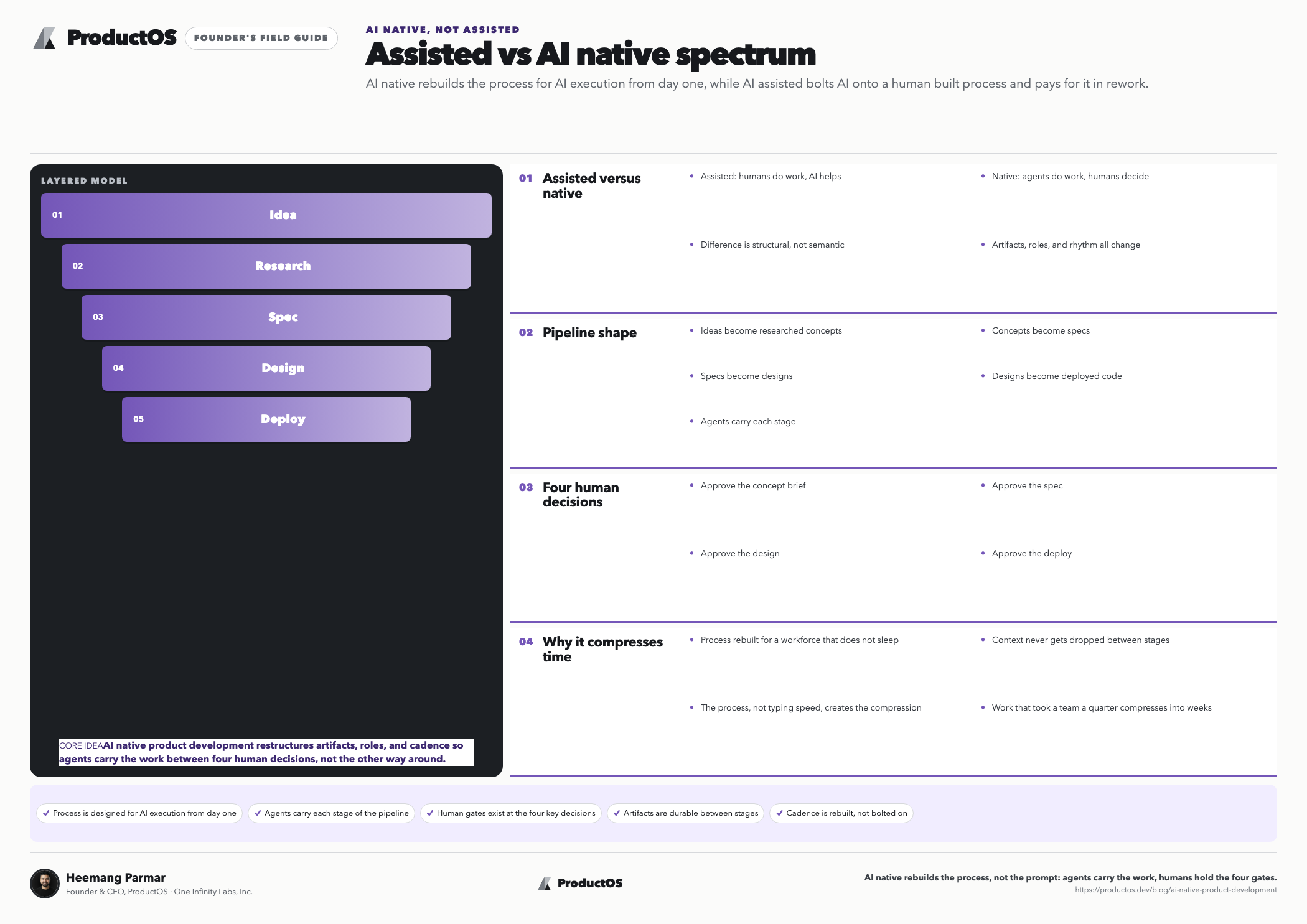
AI-native product development means designing your product process around AI from the start, instead of adding AI tools to a process built for humans. In an AI-assisted team, people do the work faster with AI help. In an AI-native team, AI systems do the work, and people direct, decide, and verify. The difference sounds semantic and is actually structural: it changes your artifacts, your roles, and your operating rhythm.
The practical shape is a pipeline. Ideas become researched concepts, concepts become specs, specs become designs, designs become deployed code, and AI agents carry each stage while humans hold the approval gates. Work that took a team a quarter compresses into weeks, not because anyone types faster, but because the process itself was rebuilt for a workforce that never sleeps and forgets everything you do not write down.
You know the assisted version of this week already. You ask a chatbot to draft a PRD on Monday, spend Tuesday fixing what it invented, and re-explain the whole product to a different tool on Wednesday. The AI-native version looks different: the research, the spec, and the build feed each other automatically, and your job is the four decisions in between.
I run my company this way, so this guide is the operator’s version: what AI-native actually means, how it differs from the assisted middle ground most teams are stuck in, the patterns that make it work, and what it honestly changes for founders, PMs, and developers. For the working example behind it all, see how the five-stage pipeline works.
What is AI-native product development?
AI-native product development is an operating model in which AI agents perform the stages of product work, research, specification, design, coding, testing, and humans set direction and approve outputs. The process, artifacts, and team structure are designed for AI execution from day one, rather than retrofitted around it.
The cleanest test for whether something is AI-native: remove the AI and see what is left. Take Copilot away from an AI-assisted team and everything still works, just slower, because the process was always human-shaped. Remove the agents from an AI-native pipeline and there is no process left to run, the same way there is no “offline version” of a cloud-native company. The AI is the workforce, not the accessory.
The term deliberately echoes cloud-native, and the analogy earns its keep. Cloud-native never meant renting servers in someone else’s building; it meant rearchitecting for elasticity, and companies that merely lifted and shifted got the bill without the benefit.
The same split is happening now. Per Stack Overflow’s 2025 developer survey, 84% of developers use or plan to use AI tools, so tool adoption is effectively finished. What remains rare is process redesign, and that gap between adoption and redesign is where most of the frustration with AI at work actually lives.
AI-native is also not the same thing as reckless. The loudest version of AI building is vibe coding, prompting without process, and its collapse modes are well documented. AI-native sits at the opposite pole: more written process than a traditional team, not less, because agents need explicit context far more than colleagues do.
How is AI-native different from AI-assisted?
AI-assisted means humans execute the work with AI accelerating individual tasks. AI-native means AI executes the work with humans directing it at defined gates. The dividing line is who holds the loop: the assisted worker prompts forty times a day, the AI-native operator reviews finished stage outputs and decides what happens next.
Laid side by side, the two models differ on every structural dimension:
| Dimension | AI-assisted | AI-native |
|---|---|---|
| Who executes | Humans, faster | AI agents, gated by humans |
| Where AI sits | Inside individual tools | As the pipeline itself |
| Context | Re-explained in every prompt | One shared project memory all agents read |
| Artifacts | Documents for humans | Documents that are also machine inputs: the spec is what agents build from |
| Human role | Producer | Editor and decision maker |
| Unit of review | A draft, a diff | A stage output: findings, a spec, a verdict |
| Failure mode | Slower than promised | Confidently wrong without gates |
The artifacts row is the one teams underestimate. In an AI-native pipeline, the requirements document is not paperwork; it is source code for the build, read by the agents that produce the design and the software. Ambiguity in it becomes wrong features, which is why AI-native teams write tighter specs than traditional ones, and why the discipline of spec-driven development sits at the center of the model.
The failure-mode row deserves equal honesty. AI-assisted work fails gently: you just go slower. AI-native work fails sharply: an ungated pipeline will research, spec, design, and build the wrong product with total confidence. The gates are not bureaucracy, they are the safety system.
How do you tell which one your team is running?
Run a quick audit against five questions, answered honestly for the last feature you shipped:
- Could the work have continued if every AI tool disappeared for a week? If yes, you are assisted.
- Is there one written context an AI system could read to understand the product, or does the truth live in heads and threads?
- Did AI produce any stage output end to end, findings, a spec, a working build, or only fragments a human assembled?
- Are there named gates where a person approves before work flows downstream?
- Was anything verified by a system other than the one that produced it?
Most teams score one out of five. That is not a failure; it is a map of the distance between owning AI tools and running an AI-native process.
What does an AI-native product process look like?
It looks like a pipeline of five stages, each run by specialized agents, each producing a durable artifact the next stage consumes. Ideation produces a concept brief, discovery produces sourced research, definition produces the spec, design produces flows and a design system, development produces tested, deployed code.
The stage-by-stage rhythm, as it runs in practice:
- Ideate. A questioning agent sharpens a raw idea into a concept brief, logging every assumption that must hold. Nothing generates yet; the output is clarity.
- Discover. A research agent pressure-tests those assumptions against the live market: competitors, reviews, community complaints, every claim linked to a source a human can click and check.
- Define. The evidence becomes a product requirements document with scope, user stories, and success metrics. This is the hinge artifact of the whole model, the single source of truth every later stage reads. You can feel the difference this makes with the free AI PRD generator: a spec in minutes that an agent can actually build from.
- Design. User flows, screen specs, and a token-based design system come from the spec, so the interface expresses the requirements instead of a model’s generic taste.
- Develop. A coding agent builds on those exact tokens in a live sandbox, a QA agent verifies the result in a real browser, and a deploy agent ships to infrastructure the team owns.
Two properties distinguish this from a fancy to-do list. First, context compounds: each artifact feeds every downstream agent, so the pipeline gets smarter about the product as it moves, rather than forgetting it between tools. Second, verification is structural, not optional: a stage is done when its output survives review, not when an agent says so. How the agents coordinate to make that happen is its own subject, covered in the companion pillar on agentic product development.
What are the core patterns of AI-native development?
Five patterns recur in every AI-native operation that actually works: shared context, spec as source of truth, specialized agents, human approval gates, and verification loops. Teams that adopt the tools without these patterns get AI-assisted results and AI-native invoices. The patterns are the model; the tools are interchangeable.
Shared context. One project memory, readable by every agent: the concept, the findings, the spec, the design decisions. Anything not written into it does not exist, because agents have no hallway conversations. AI-native teams write more than traditional teams, and the writing is the infrastructure.
Spec as source of truth. Every downstream artifact traces to the spec, and disagreements resolve by reading it, not by remembering meetings. When the product changes, the spec changes first.
Specialized agents. One job per agent, with narrow instructions and only the tools that job needs. Researcher, spec writer, designer, builder, tester: focus beats generality at every stage. This mirrors the agentic design patterns Andrew Ng popularized, reflection, tool use, planning, and multi-agent collaboration, applied to product work specifically.
Human approval gates. People sign off where reversal is expensive: the concept, the spec outline, the design direction, the deploy. Gate the irreversible, automate the redoable.
Verification loops. Output is tested by something other than its author, ideally against the real artifact: the app in a real browser, the claim against its source. Failed verification feeds back into an automated fix, so quality is a loop, not a hope.
None of these patterns is exotic. They are what good product organizations always did, made mandatory: an agent workforce simply removes the option of compensating for missing process with hallway heroics.
What changes for founders, product managers, and developers?
Everyone moves up one level of abstraction. Founders stop trading product ambition against engineering budget. Product managers stop writing tickets about work and start approving the work itself. Developers stop typing most of the code and start owning architecture, judgment, and the hard 30% that agents cannot close.
| Role | Yesterday’s constraint | The AI-native version |
|---|---|---|
| Founder | Ideas queue behind engineering capacity | Runs the full idea-to-deploy pipeline solo; capital buys distribution, not headcount |
| Product manager | Writes specs others may or may not build | The spec is executed directly; the PM’s clarity becomes the product’s quality |
| Developer | Types most of the code | Directs and reviews agents; owns architecture, security, and the hardest problems |
| Designer | Handoffs that die in translation | Locks direction and tokens; agents build on the exact system, screen for screen |
For founders, the deepest change is that the scarce resource moves from build capacity to judgment: what to build, for whom, and when to say no. For product managers, writing becomes the highest-leverage skill in the role, because an AI-native spec is executable. For developers, the shift is real but not the one the headlines sell: less typing, more verification, and more weight on the decisions that were always the actual job.
The honest caveat: this transition has losers as well as winners. Work that consisted mainly of predictable execution, routine CRUD builds, ticket triage, production-line design assets, is being absorbed by pipelines. The durable roles concentrate judgment, taste, and accountability. Pretending otherwise would make this a worse guide.
How do you adopt AI-native development without breaking your team?
Adopt artifacts first, then agents, then autonomy. Start by making one stage AI-native end to end, usually research or the spec, prove the output survives human review, then extend downstream. Teams that flip everything at once usually revert within a month, because trust in agent output has to be earned stage by stage.
The sequence that works:
- Fix the writing first. If your product decisions live in meetings and DMs, agents have nothing to read. Establish the concept brief and the spec as real documents before any automation.
- Go AI-native in one stage. Research is the safest start: agent-produced, source-linked findings are easy to verify and immediately useful. The spec is the next candidate.
- Add gates before you add speed. Decide who approves what before the pipeline runs fast enough to outpace your review habits.
- Extend to design and build. Once specs are trustworthy, let agents carry them into flows, tokens, and code, with verification in a real browser before anything ships.
- Measure stage by stage. Time per stage, rework rate, and how often verification fails. Falling rework is the signal the model is working; rising rework means your artifacts are still too vague.
And the two-sided version, because AI-native is not universally right: if you operate in a heavily regulated domain, maintain a large legacy codebase, or ship one small product a year, the assisted model may honestly serve you better today. AI-native pays off in proportion to how much new product work you generate. If that number is high, every quarter on the old model is compounding opportunity cost.
Tips
- Start AI-native on one new project, not a migration; retrofitting an old process fights every habit your team already has.
- Make context explicit and shared, so research, spec, design, and code all read from the same source instead of re-explaining.
- Keep a human as the accountable owner at each stage; AI-native shifts who does the typing, not who makes the call.
- Ship end to end on a small scope first to feel where context breaks, then widen.
- Measure the gap between what you specified and what shipped; in an AI-native process it should approach zero.
How does ProductOS implement AI-native product development?
ProductOS is the AI-native model as a working product: ten specialized agents (Orchestrator, Ideation, Research, PRD, Architect, Design, Design System, Fullstack Builder, QA, Deploy) sharing one project context across five stages, Ideate, Discover, Define, Design, Develop.
The patterns above are implemented literally. Research findings carry clickable sources. The PRD is written section by section behind an outline approval gate.
The design system is generated from your locked brand, and the Fullstack Builder codes on those exact tokens in an isolated cloud sandbox with a live preview. The QA agent verifies in real headless Chromium and returns a pass, partial, or fail verdict. The Deploy agent preflights, pushes to your own GitHub, and self-fixes up to three times. Model routing is BYOK and multi-provider, so no model is hardcoded anywhere.
The proof is shipped software: SOLEN, Orbit, StudioFlow, Lumen Notes, Echo, and Reserva all went through this pipeline and run in production. Each specialist is documented at the agents page.
Frequently asked questions
What is AI-native development?
AI-native development is building products with a process designed around AI execution from the start: agents perform the research, specification, design, coding, and testing, while humans set direction and approve at gates. It differs from AI-assisted development, where humans still execute everything and AI only accelerates tasks. The test: remove the AI, and an AI-native process has nothing left to run.
What are the four patterns of AI-native development?
The phrase usually points to Andrew Ng’s four agentic design patterns: reflection, where AI critiques and improves its own output; tool use, where it acts through search, code, and APIs; planning, where it decomposes goals into steps; and multi-agent collaboration, where specialized agents divide the work. In product development these translate into verification loops, agent tooling, staged pipelines, and specialist agents sharing one context.
Is AI-native the same as AI-first?
They overlap but point at different things. AI-first is usually a strategy statement: AI is the priority in what a company builds and buys. AI-native describes architecture: the process itself is designed for AI execution and does not exist without it. A company can declare itself AI-first while every workflow stays human-shaped. AI-native is the structural version, visible in artifacts and roles rather than announcements.
Can an existing product team become AI-native?
Yes, and gradually is the way that sticks. The proven sequence: make your artifacts real first, since agents can only read what is written down, then convert one stage at a time, starting with research or the spec, adding approval gates before speed. Most teams see the model prove itself within one product cycle. Flipping every stage at once usually collapses trust and triggers a reversion.
What is the 30% rule in AI?
It is the informal heuristic, articulated by engineer Addy Osmani as the 70% problem, that AI carries roughly the first 70% of a piece of work with ease while the final 30%, edge cases, integration, hardening, judgment, still demands human skill. The rule is a caution against demo-driven confidence: plan and staff for the last 30%, because that is where products are actually won.
What is the $900,000 AI job?
It refers to a widely reported 2023 Netflix job listing for an AI product manager with total compensation up to roughly $900,000, which became shorthand for how aggressively companies price applied AI judgment. The durable signal is not one salary but the pattern behind it: pay concentrates on people who can direct AI systems toward the right product, not on any single tool skill.
Do AI-native teams still need developers?
Yes, differently deployed. Agents now produce most routine application code, but architecture decisions, security review, novel algorithms, and the hardest debugging remain human work, and per Stack Overflow’s 2025 developer survey, nearly half of developers distrust AI output accuracy, which is exactly why verification is a growth role. AI-native teams tend to employ fewer pure implementers and lean harder on engineers with system-level judgment.
Is ProductOS an AI-native tool or an AI-assisted tool?
AI-native, by the definition this guide uses: the five-stage pipeline is executed by ten specialized agents sharing one project context, and humans direct it at approval gates rather than performing the stages themselves. Whether that model fits you depends on your volume of new product work; teams maintaining one legacy system may honestly get more from assisted tools, which is a trade this guide covers openly.
Where should you go from here?
AI-native product development is a redesign, not an upgrade: shared context, executable specs, specialist agents, human gates, and verification loops. Adopt the patterns in that order and the tools become almost incidental. The fastest way to understand the model is to watch it run: walk through the five-stage pipeline, then put one real idea through it and judge the artifacts for yourself.
CS engineer and IIM Lucknow MBA. Built products across enterprise and AI for 10+ years. Founded ProductOS to give every PM and founder the leverage of a full product team. Writes about AI product development, PRDs, and building with agents.