What is vibe coding? The complete guide for 2026

Vibe coding is building software by describing what you want to an AI in plain language and accepting the code it writes, mostly without reading it. Andrej Karpathy coined the term in February 2025, describing a style where you “fully give in to the vibes” and forget the code exists. Within a year, Collins Dictionary named vibe coding its 2025 word of the year.
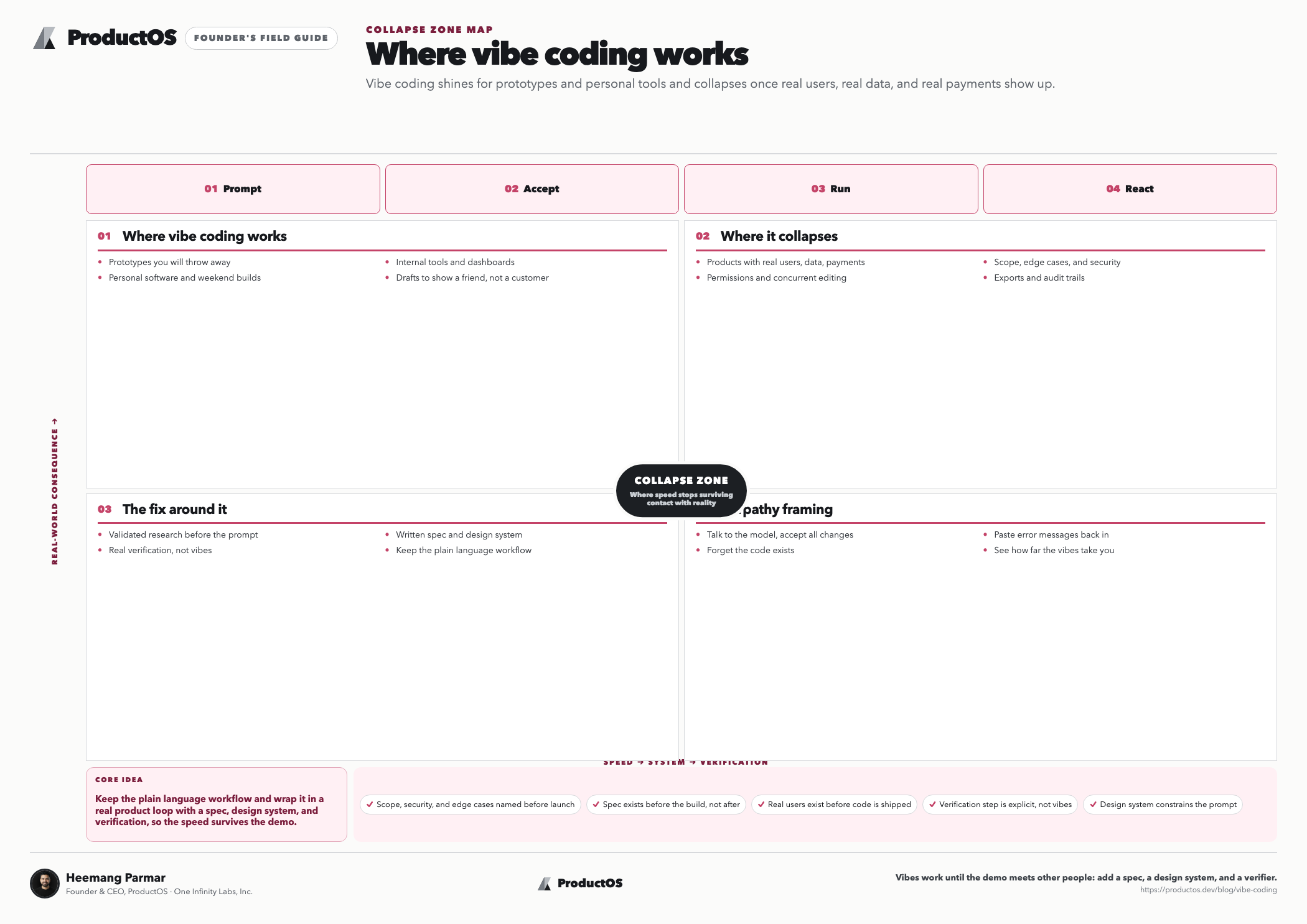
Here is the honest answer up front. Vibe coding works, and works well, for prototypes, internal tools, and personal software. It collapses for products with real users, real data, and real payments, because casual prompts alone cannot carry scope, edge cases, or security.
The fix is not to stop vibe coding. The fix is to keep the plain-language workflow and put a product process around it: validated research, a written spec, a design system, and real verification.
You have probably lived the arc already. You describe a dashboard to an AI builder on a Tuesday night, and by midnight it works: charts, filters, even a login page. You show a friend, they sign up, and within a week the requests start: exports, permissions, a bug when two people edit at once. Every fix now breaks something else. That moment, when the demo meets other people, is what this guide is about.
This guide covers what vibe coding means, where it genuinely shines, exactly how it fails, and how to keep the speed without the collapse. If you want to see the structured version working, start with the ProductOS AI app builder.
What is vibe coding?
Vibe coding is a way of building software where you prompt an AI tool in natural language, accept the generated code without reviewing it line by line, and steer by running the app and reacting to what you see. The conversation is the interface. The code is a byproduct you rarely open.
Karpathy’s original framing was deliberately loose: talk to the model, accept all changes, paste error messages back in, and see how far the vibes take you. He positioned it as an experiment for throwaway weekend projects, not a methodology.
The internet promoted it to a methodology anyway, because the underlying capability jump was real. Tools like Lovable, Bolt, v0, Cursor, and Replit turned a single English sentence into a running application, and millions of people who never wrote code started shipping software.
The adoption numbers back this up. Per Stack Overflow’s 2025 developer survey, 84% of developers use or plan to use AI tools in their workflow. The same survey found that nearly half of developers distrust the accuracy of AI output, which is the tension this entire guide lives inside: the tools are everywhere, and skepticism about what they produce is rising at the same time.
One boundary worth drawing early, because it changes every argument that follows. If you read and verify every line the AI writes, you are doing AI-assisted development, not vibe coding. Vibe coding specifically means not reviewing the code. That definition is what makes it fast, and it is also what makes it fragile. Keep that trade in view and the rest of the debate gets much simpler.
When does pure vibe coding actually work?
Pure vibe coding works when the cost of being wrong is low: prototypes, weekend projects, internal tools, learning exercises, and personal software. If nobody else depends on the app, iteration speed matters more than code quality, and you can throw the result away, vibing is the rational choice, not a guilty shortcut.
I want to be specific here, because most criticism of vibe coding skips this part. There are real situations where adding process would be the mistake:
- Idea validation. You have a concept and need something clickable in front of five potential customers this week. A vibe-coded prototype answers “would anyone use this” faster and cheaper than any document. If the answer is no, you saved a month.
- Internal tools. A dashboard for your own team, a script that reformats a report, a calculator for one workflow. The user count is five, the data is yours, and the blast radius of a bug is an annoyed coworker.
- Personal software. Tools built for an audience of one. This category barely existed before 2025 because the economics never worked. Now a habit tracker shaped exactly to your life costs one evening.
- Learning and exploration. Vibe coding a project and then reading what the AI built is a genuinely good way to learn a new framework. The vibes write, you study.
- Demos and pitches. Investors and stakeholders respond to working software. A prototype that exists beats a deck that describes one.
The common thread is disposability. Every one of these outputs can be deleted without consequence. The moment an app stops being disposable, the moment it holds someone else’s data or takes someone else’s money, the calculus flips. That flip point, not the tooling, is what most vibe coding arguments are actually about.
Why does vibe coding fail?
Vibe coding fails when the software outlives the session that produced it. The recurring collapse modes: the AI loses context as the app grows, requirements that only lived in chat get silently dropped, security is assumed rather than verified, and nobody can maintain code that nobody read. Each traces to missing structure, not weak models.
The failure pattern is consistent enough that you can table it:
| Failure mode | What it looks like | Root cause |
|---|---|---|
| Context drift | The AI breaks working features while adding new ones | The app outgrew the model’s context window; no persistent spec to re-anchor it |
| Scope amnesia | Requirements discussed in chat never ship, and nobody notices for weeks | Chat history is not a spec; nothing durable records what the product must do |
| Security debt | Exposed API keys, missing auth checks, databases reachable from the open internet | Code accepted without review, testing, or a deploy checklist |
| Unmaintainable code | Every new change takes longer than the last; fixes break other fixes | No architecture decisions were ever made; the codebase is sediment, not structure |
| The last 20% | Demo in a day, production date that keeps slipping | Edge cases, real data, payments, and error handling need judgment the vibes never supplied |
The last row deserves expansion because it is the one that surprises founders most. Engineer Addy Osmani calls it the 70% problem: AI gets you through the first 70% of a build at astonishing speed, and the remaining 30%, the part involving edge cases, data integrity, and production hardening, resists the same approach. The demo creates a feeling of being nearly done that the calendar then corrects.
Notice what is absent from that table: the model. None of these failures are primarily about AI capability, and waiting for a smarter model will not fix them. They are process failures.
A human team with no requirements, no design decisions, no code review, and no testing would fail the same way, just slower. Vibe coding did not invent these problems. It compressed the timeline enough to make them visible in week two instead of year two. The context problem in particular has its own discipline now; the guide to context engineering covers how teams keep AI anchored on long builds.
How do you know when vibe coding stops being enough?
The flip point rarely announces itself. Watch for these signs that your prototype has crossed from disposable to depended-on:
- Someone else’s data lives in it. The moment a user other than you stores real information, a lost record becomes a broken promise.
- Money moves through it. Payments raise the cost of every bug from annoyance to refund, and of every security gap to liability.
- You are afraid to change it. If adding a feature feels like surgery on a patient you have never met, the codebase has outgrown the chat that made it.
- The same bug returns twice. Recurring regressions mean fixes are overwriting each other, which is the signature of context drift.
- You cannot answer a security question. If “where are the API keys” draws a blank, stop shipping and start reviewing.
Two or more of these and the app has earned a process. The rest of this guide is what that process looks like.
Is vibe coding better than traditional coding?
Neither wins outright. Vibe coding reaches a working demo faster by an order of magnitude and opens building to people who cannot code. Traditional development still wins on reliability, security, and long-term maintainability. The useful question is not which is better, but which fits the job in front of you right now.
Here is the comparison laid out honestly, including the third option most comparisons omit:
| Pure vibe coding | Traditional development | Vibe coding with a product process | |
|---|---|---|---|
| Time to first demo | Hours | Weeks | Hours to days |
| Who can do it | Anyone | Engineers | Anyone |
| Requirements | Live in chat, then evaporate | Written and versioned | Written spec the AI builds from |
| Code quality | Unknown, unread | Reviewed | Generated, then verified by testing |
| Security | Assumed | Engineered | Checked before deploy |
| Cost of change at month three | High and rising | Low | Low, the spec re-anchors every change |
| Best for | Prototypes, throwaway tools | Complex or regulated systems | Real products without an engineering team |
Two honest caveats on that table. First, traditional development is not going anywhere for genuinely complex systems: novel algorithms, regulated industries, infrastructure at scale. If that is your product, hire engineers. Second, the third column is not free. Writing a spec and reviewing research takes hours you could spend prompting. The return arrives at week three, when the pure vibe coder is rewriting from scratch and you are shipping feature twelve against the same document.
How do you vibe code with a product process?
Keep the natural-language workflow and add four durable artifacts around it: research that validates the idea, a written spec the AI builds from, a design system so screens look intentional, and verification that tests the result in a real browser. The prompts stay casual. The artifacts carry the memory the chat cannot.
This is the approach I run, and it maps to five steps:
- Sharpen the idea before anything generates. Write down the problem, the target user, and the assumptions that must hold. Vague in, generic out is the most reliable law of AI building.
- Validate with real research. Check competitors, read the complaints in their reviews, and confirm the gap exists. AI market research compresses this from weeks to a session, and it kills bad ideas while they are still cheap.
- Write the spec. A short product requirements document converts intentions into commitments: scope, user stories, and what “done” means. This document is what re-anchors the AI when the chat drifts. You can draft a PRD free with the AI PRD generator in a few minutes.
- Lock design before code. Colors, type, and components decided once and reused everywhere. This is the difference between a product that looks intentional and one that looks generated.
- Verify before you ship. Test the actual flows in an actual browser: signup, payment, the empty states, the error paths. Then deploy to infrastructure you own.
The spec-first version of this idea has its own name and its own discipline; the full treatment is in our guide to spec-driven development. And when the agents running each of these steps hand work to each other automatically, you get agentic product development, which is where this whole space is heading.
What surprises people is how little the day-to-day feeling changes. You still describe features in plain English. You still iterate by reacting to a live preview. The difference is that every prompt lands against a spec and a design system instead of against whatever the model happens to remember, so week three feels like week one instead of feeling like an excavation.
Tips
- Start every session by pasting the spec, not by summarizing the app from memory.
- Ask the AI to restate the requirement in its own words before it writes code; mismatches surface early.
- Commit after every working change so a bad generation is a revert, not an excavation.
- Test the empty states, the error paths, and the second user; the demo path always works.
- Never let the AI store secrets in code, and check for exposed keys before every deploy.
Which vibe coding tool should you pick?
Pick by what happens after the first demo. Lovable and Bolt are excellent for fast, polished prototypes. v0 is the strongest choice for React interfaces. Cursor and Replit suit builders who will actually read the code. ProductOS fits when the goal is a shipped product and the process around the code matters.
We build an AI app builder, so treat this as an operator’s view with that bias declared. It also means we know these tools from the inside, and the honest matchups look like this:
| Tool | Pick it when | Trade-off to accept |
|---|---|---|
| Lovable | You want the fastest path to a beautiful web prototype | Process, research, and spec are on you |
| Bolt | You want quick full-stack scaffolding in the browser | Same: it starts at the build step |
| v0 | You need React UI components and you ship into an existing codebase | It is a UI generator, not a product pipeline |
| Cursor | You are technical and want AI speed with code you review | That is AI-assisted development; you have left vibe coding |
| Replit | You want to build, host, and learn in one environment | Best experience assumes some willingness to touch code |
| ProductOS | You want the idea researched, specced, designed, built, tested, and deployed as one pipeline | The stages before code take hours, not minutes |
Said plainly: if you are validating an idea this weekend, Lovable or Bolt will serve you well and you should use them. If you are a developer, Cursor is probably your answer.
The gap ProductOS exists to fill is the person who has watched a prototype collapse under real users and wants the product process built in rather than bolted on. Full head-to-head breakdowns live on our comparison hub, including the cases where the honest answer is the other tool. For a ranked view of the whole field, see the guide to the best AI app builders.
How does ProductOS handle vibe coding?
ProductOS keeps the plain-language workflow and runs a product process underneath it. Ten specialized agents share one project context across five stages: Ideate, Discover, Define, Design, Develop. Research is grounded in sources you can click. The PRD is written section by section behind an outline approval gate, so the spec is yours before anything gets built.
The build itself runs in an isolated cloud sandbox with a live preview, on the exact design tokens the Design stage produced. The QA agent then verifies the app in real headless Chromium and returns a pass, partial, or fail verdict, and the Deploy agent preflights the build, pushes the code to your own GitHub, and self-fixes up to three times if the deploy breaks. You own the code and the domain from day one.
The showcase is the proof: SOLEN, an architecture studio site; Orbit, a web game holding 60fps on mobile; StudioFlow, a photographer CRM with billing. Real products, built through the pipeline. See how the five stages fit together.
Frequently asked questions
What exactly does vibe coding mean?
Vibe coding means building software by prompting an AI in natural language and accepting the generated code without reviewing it. You steer by running the app and describing changes, not by reading the source. Andrej Karpathy coined the term in February 2025. The defining trait is the absence of code review: if you verify every line, you are doing AI-assisted development instead.
Why did vibe coding fail?
Vibe coding did not fail as a technique; it failed as a substitute for a product process. Projects collapsed when unreviewed code met real users: security holes, features silently dropped as chat context overflowed, and codebases nobody could maintain. The failures trace to missing specs, missing testing, and missing design decisions, which is why teams that added those artifacts kept the speed without the collapse.
Is vibe coding better than coding?
For speed to a working demo, yes, by an order of magnitude, and it works for people who cannot code at all. For reliability, security, and maintainability, traditional coding still wins. The practical answer depends on the job: vibe code prototypes and disposable tools, engineer complex or regulated systems, and use a structured AI pipeline for real products in between.
How can you tell if someone is vibe coding?
Ask what happens when something breaks. A vibe coder pastes the error back into the AI and hopes; someone who knows their codebase can say where the problem likely lives. Other tells: they cannot explain how auth or data storage works in their own app, the git history is one giant commit, and requirements exist only as a chat transcript.
Will vibe coding replace programmers?
No, but it is redistributing the work. Prototypes, internal tools, and simple apps no longer require an engineer, which is a genuine shift. Complex systems, novel algorithms, infrastructure, and anything regulated still demand engineering judgment, and per Stack Overflow’s 2025 developer survey, nearly half of developers distrust AI output accuracy, so verification skills are gaining value rather than losing it. The scarce skill is moving from writing code to specifying and verifying it.
What is the difference between vibe coding and spec-driven development?
Vibe coding starts from a conversation; spec-driven development starts from a written document that defines scope, user stories, and acceptance criteria before generation begins. The spec gives the AI a stable source of truth that survives chat drift, which is exactly what pure vibe coding lacks. The two combine well: casual prompts for iteration, a spec as the anchor every prompt lands against.
Can you vibe code a mobile app?
Yes. Modern AI builders generate mobile apps from the same plain-language prompts, usually via cross-platform frameworks like React Native or as progressive web apps. The same rules apply, though app store review raises the bar: a crashing web demo is private, a rejected store submission is a delay. Specs and real-device testing matter more for mobile, not less. See the AI mobile app builder for how ProductOS handles it.
Where does ProductOS fit if I already vibe code with Lovable or Cursor?
Those tools start at the build step; ProductOS starts at the idea. If your current workflow produces good prototypes that keep dying on the way to production, the missing pieces are usually research, a spec, and verification, which is the part of the pipeline ProductOS runs before and after code generation. If your prototypes are disposable by design, your current tool is probably the right one.
Where should you go from here?
Vibe code your prototypes. Genuinely, keep doing it: it is the cheapest idea-validation instrument ever built. But the moment an idea earns real users, give it a process: research, a spec, a design system, and verification. That is the difference between a demo and a product, and it is the entire reason ProductOS exists.
Start building free on ProductOS and take one idea from vibe to shipped, with the process handled for you.
CS engineer and IIM Lucknow MBA. Built products across enterprise and AI for 10+ years. Founded ProductOS to give every PM and founder the leverage of a full product team. Writes about AI product development, PRDs, and building with agents.