Agentic workflows: automating the product pipeline

An agentic workflow is a sequence of tasks where AI agents, not people, do the work between the decisions: they plan, call tools, write and test code, and hand off to the next stage, while a human approves the gates that matter. Applied to product development, it turns the pipeline from a relay race of tickets and handoffs into a continuous flow where the context never gets dropped between stages.
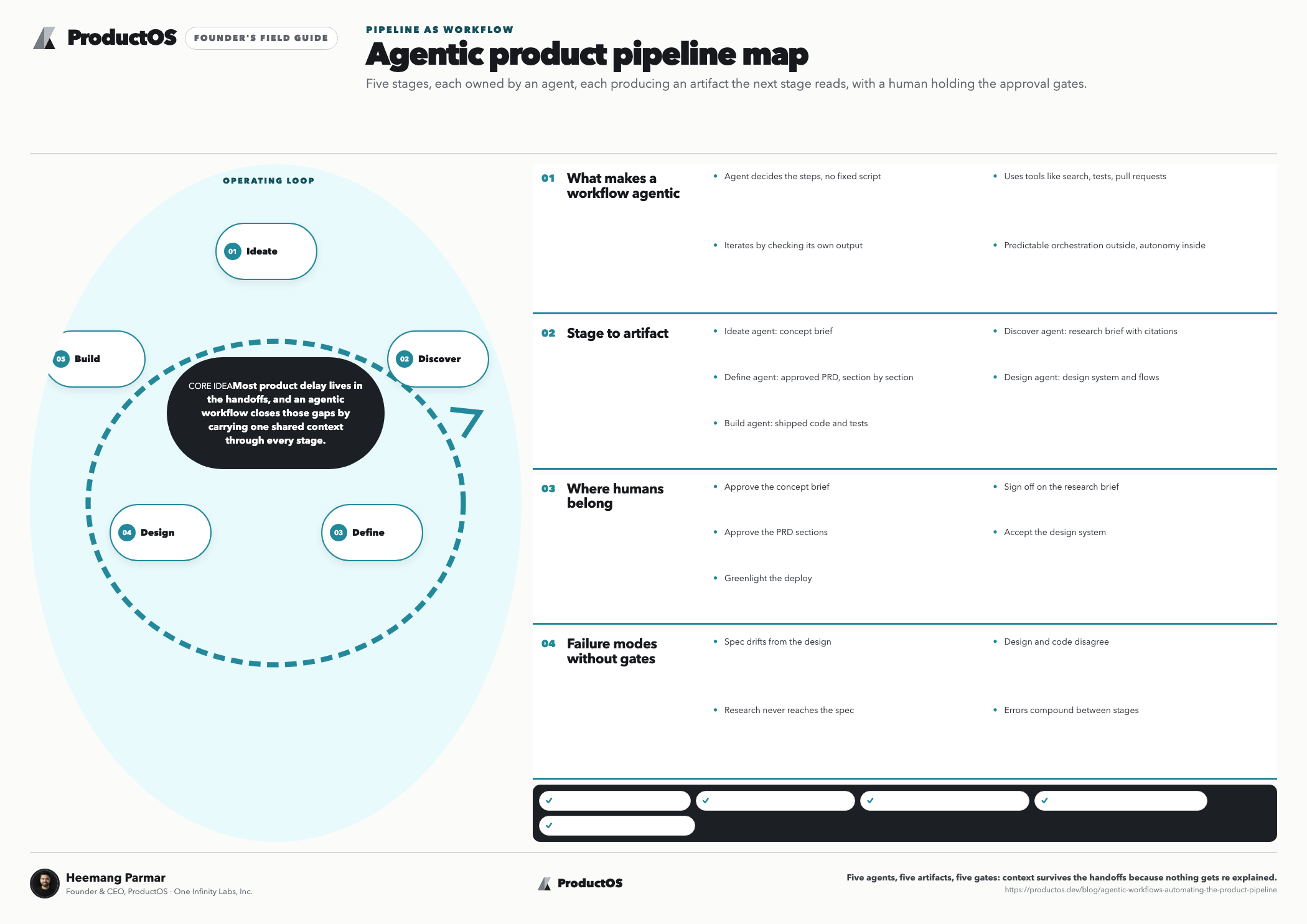
That last part is the whole point. Most product teams do not lose time because any single stage is slow. They lose it in the gaps, when research does not reach the spec, when the spec drifts from the design, when the design and the code disagree. Agentic workflows exist to close those gaps by keeping one shared context moving through the pipeline.
What makes a workflow “agentic”
A plain automation runs a fixed script. An agentic workflow is different in three ways. The agent decides the steps rather than following a hardcoded list. It uses tools, calling a search API, running a test suite, opening a pull request. And it iterates, checking its own output and trying again when a test fails. Anthropic draws a useful line here between workflows, where models follow predefined paths, and agents, which direct their own process and tool use. Most production systems are a mix: predictable orchestration on the outside, agent autonomy inside each step.
The product pipeline as an agentic workflow
At ProductOS the pipeline runs as five stages, each owned by an agent, each producing an artifact the next stage reads. It is the clearest example of what an agentic product workflow looks like end to end.
- Ideate. A Socratic agent sharpens a raw idea into a testable concept, logging every assumption. Output: a concept brief.
- Discover. A research agent pressure-tests those assumptions against the market and cites every claim. Output: a research brief.
- Define. A PRD agent turns the research into an approved spec, section by section. Output: the source of truth.
- Design. A design agent produces flows, screens, and a design system from the spec. Output: a real design.
- Develop. A coding agent builds it in a live sandbox, a QA agent tests it in a real browser, a deploy agent ships it. Output: a deployed product.
The reason this works is that each artifact carries the context forward. The spec is written against the actual research, the design is built against the actual spec, the code is built against the actual design. Nothing is re-explained, and nothing is guessed.
Where humans stay in the loop
Agentic does not mean unattended. The workflow is built around approval gates: you sign off the concept before research starts, approve the PRD outline before sections are written, and review the design before a line of code is generated. The agents do the labor between the gates; you make the decisions at them. That is the split that keeps speed without losing control, and it is the same discipline behind spec-driven development, where a reviewed spec is what lets an agent build safely.
How to start building agentic workflows
You do not need the whole pipeline on day one. Start where the handoff pain is worst.
- Pick one gap. The research-to-spec handoff is usually the most expensive. Automate that first: an agent that reads your research notes and drafts the PRD.
- Make the artifact explicit. Every agentic step should produce a document the next step can read. If the output is only in a chat window, the context dies there.
- Keep a gate. Put a human approval between the risky step and the next one. You can remove gates later as trust builds; you cannot easily add them after a bad ship.
- Give agents real tools. The leverage comes from tool use, running the test, opening the PR, not from a better paragraph. Wire the agent into your actual stack.
Frequently asked questions
What is an agentic workflow?
An agentic workflow is a process where AI agents handle the work between human decisions: they plan the steps, use tools like search and test runners, iterate on their own output, and pass an artifact to the next stage. It differs from plain automation because the agent chooses how to reach the goal rather than following a fixed script.
How are agentic workflows different from automation?
Automation runs a predefined sequence. An agentic workflow lets the agent decide the sequence, call tools, and retry when something fails. In practice most systems combine both: predictable orchestration around the edges, agent autonomy inside each step.
Do agentic workflows remove humans from the process?
No. The good ones are built around approval gates. Agents do the labor between the gates, and a person makes the call at each gate, approving the concept, the spec, and the design before the next stage runs. That keeps the speed of automation with the judgment of a human.
How do I start with agentic product development?
Automate one handoff first, usually research to spec, make each step produce an explicit artifact the next step can read, keep a human approval gate on the risky transitions, and give the agent real tools so it can run tests and open pull requests, not just write text.
CS engineer and IIM Lucknow MBA. Built products across enterprise and AI for 10+ years. Founded ProductOS to give every PM and founder the leverage of a full product team. Writes about AI product development, PRDs, and building with agents.