Kimi K3 vs Claude Fable 5 vs GPT-5.6 Sol: the coding benchmark for builders

On July 16, Moonshot AI shipped Kimi K3, the largest open-weight model released to date at 2.8 trillion parameters. Within a day it was being benchmarked against the two closed frontier models most teams actually ship on: Anthropic’s Claude Fable 5 and OpenAI’s GPT-5.6 Sol. The headline that spread fastest was that an open model had cracked the top four. The more useful question, if you are choosing which model writes your production code, is narrower: which of these three should you build with, and why.
This is a comparison for builders, not a leaderboard recap. That means being honest about something most benchmark posts skip. These numbers are not directly comparable to each other, and the right pick has as much to do with price and openness as with any single score.
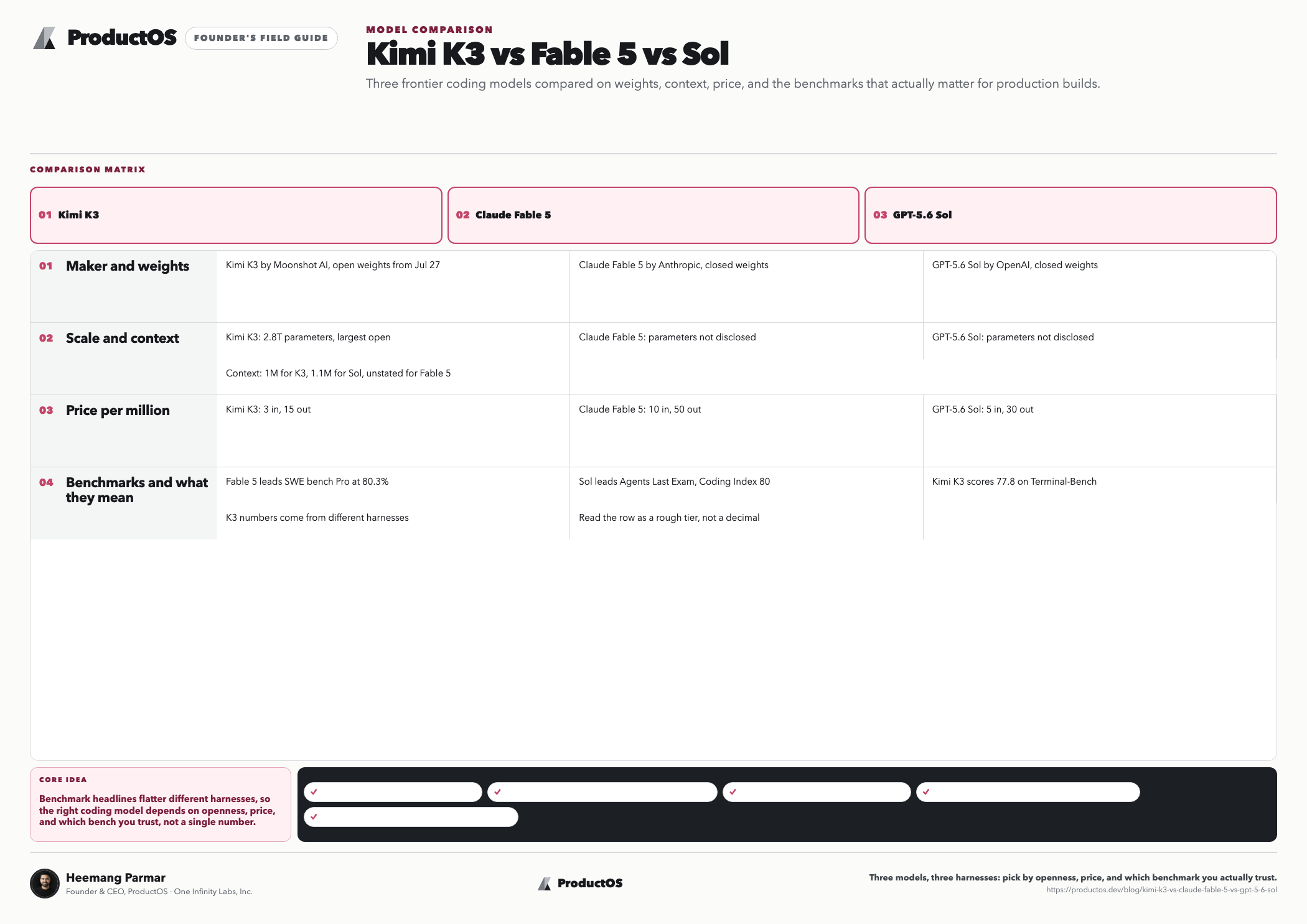
Kimi K3 vs Claude Fable 5 vs GPT-5.6 Sol: the numbers
| Kimi K3 | Claude Fable 5 | GPT-5.6 Sol | |
|---|---|---|---|
| Maker | Moonshot AI | Anthropic | OpenAI |
| Weights | Open (Jul 27) | Closed | Closed |
| Parameters | 2.8T (largest open) | Not disclosed | Not disclosed |
| Context window | 1M | Not stated | 1.1M |
| Price (in / out per 1M) | $3 / $15 | $10 / $50 | $5 / $30 |
| SWE-bench Pro | ~67.5 * | 80.3% | 64.6% |
| Standout | Tops Program Bench (77.8); #1 open-weight on frontend coding | Best raw coding accuracy | #1 on Agents’ Last Exam; Coding Index 80 |
* Kimi K3’s coding scores come from harness-specific benchmarks (Program Bench, Terminal-Bench) that are not measured the same way as Anthropic’s and OpenAI’s SWE-bench Pro figures. Read the row as a rough tier, not a decimal-precise ranking.
Why the benchmark numbers deserve a pinch of salt
Every vendor reports the harness that flatters it. Anthropic leads with SWE-bench Pro, the agentic benchmark it considers most representative of production work, where Fable 5 scores about 80% against GPT-5.6 Sol’s 64.6%. OpenAI counters with agent-ability tests, where Sol takes first place on Agents’ Last Exam and posts a Coding Index of 80. Moonshot leads with Program Bench and Terminal-Bench, where K3 edges both of them by a fraction of a point.
These are different tests with different scaffolding, so a straight “77.8 beats 77.6 beats 64.6” reading is mostly noise. What survives across all of them is the shape of the field. Fable 5 is the most accurate coder, Sol is the best agent, and K3 is close enough to both that, for the first time, an open-weight model is a real production option rather than a research curiosity.
Reading each model as a build decision
Claude Fable 5: the accuracy pick, if you can afford it
Fable 5 is the model to reach for when a wrong diff is expensive: a payments flow, a migration, a security-sensitive change. Its SWE-bench Pro result is the highest of the three, and in daily use it is the one most likely to read a large codebase correctly on the first pass. The catch is price. At $10 in and $50 out per million tokens it is the most expensive of the three by a wide margin, and coding agents are output-heavy, so that $50 output number is the one that bites at scale.
GPT-5.6 Sol: the agentic all-rounder
Sol’s SWE-bench Pro number trails Fable 5, but that undersells it for how most teams use these models now: as agents that plan, call tools, run tests, and iterate. On that axis Sol leads, topping Agents’ Last Exam with the strongest overall agent metrics of the three. Its 1.1M-token context is the largest here, and at $5 / $30 it sits between the other two on price. If your workflow is agent-driven rather than single-shot completion, Sol is the safe default.
Kimi K3: the open-weight option that changes the budget
K3 is the interesting one, and not only because it is open. It tops Program Bench outright, takes first place among open-weight models on frontend coding, and lands fourth overall among frontier models, ahead of Claude Opus 4.8. It does that at $3 / $15, roughly a third of Fable 5’s price, and once the weights land on July 27 you can run it on your own infrastructure. For a team doing high-volume code generation, or one that cannot send its codebase to a third-party API for compliance reasons, that combination is the story of this release.
What this means if you build products, not benchmarks
The gap between the best closed model and the best open one has narrowed to the point where price and control matter more than the last few points of accuracy. A year ago, choosing an open model meant accepting a visible quality drop. K3 makes that trade far smaller.
For most teams the honest answer is that you will use more than one. Route the correctness-critical changes to Fable 5, run your agentic build-and-test loops on Sol, and lean on K3 for the high-volume, cost-sensitive, or privacy-bound work, especially self-hosted. This is exactly why vibe coding and spec-driven development are converging on a bring-your-own-model world. The model is becoming a swappable input, and the durable advantage is the process around it, the spec, the tests, and the review, not the specific weights you called this month. This is the bet behind model-agnostic build platforms like ProductOS, where you build in one place and point the work at whichever model wins a given job, rather than rebuilding your stack every time the leaderboard shifts.
Which AI model should you build with?
If you want one answer: start on GPT-5.6 Sol for general agentic coding, keep Claude Fable 5 on call for the changes you cannot afford to get wrong, and pilot Kimi K3 the week its weights drop, because a near-frontier open model at a third of the price is the kind of thing that quietly rewrites your inference bill. For the wider field, we keep the best AI coding tools and AI app builders updated as models ship.
Frequently asked questions
Is Kimi K3 better than Claude Fable 5 for coding?
Not on raw accuracy. Fable 5 leads SWE-bench Pro at about 80%, while K3’s coding results come from different, harness-specific benchmarks. K3’s advantage is that it is open-weight, self-hostable, and roughly a third of the price, so for high-volume or privacy-sensitive work it can be the better choice even though Fable 5 is the stronger coder.
Is Kimi K3 open source?
It is open-weight. Moonshot AI is releasing the model weights on Hugging Face on July 27, 2026, alongside a technical report, so you can run and fine-tune it yourself. That is different from fully open-source, which would include training data and code, but it is enough to self-host.
How much does each model cost?
Per million tokens, input then output: Kimi K3 is $3 and $15, GPT-5.6 Sol is $5 and $30, and Claude Fable 5 is $10 and $50. Because coding agents generate a lot of output, the output price is usually the number that decides your bill.
Which model is best for AI coding agents?
GPT-5.6 Sol currently leads the agent-specific benchmarks, taking first on Agents’ Last Exam with a Coding Index of 80, which makes it a strong default for plan-and-execute agent workflows. Fable 5 is close and more accurate per step, and K3 is the value option once you are running your own agent loop.
CS engineer and IIM Lucknow MBA. Built products across enterprise and AI for 10+ years. Founded ProductOS to give every PM and founder the leverage of a full product team. Writes about AI product development, PRDs, and building with agents.