What is AI market research? The complete guide (2026)

AI market research means using large language models, paired with live web retrieval, to do the work of a desk research team: competitor scans, market sizing, review mining, survey design, and synthesis. Done properly, it compresses two to three weeks of analyst work into a few hours. Done lazily, it produces confident fiction that reads like a McKinsey memo and cites nothing.
Picture the moment this matters. It is Tuesday, your investor call is Friday, and you need to know whether the market you are pitching exists at the size you claim. You ask an AI assistant, and forty minutes later you have competitors, sizing, and pricing, each with a link you can open. The only question left is whether any of it is true.
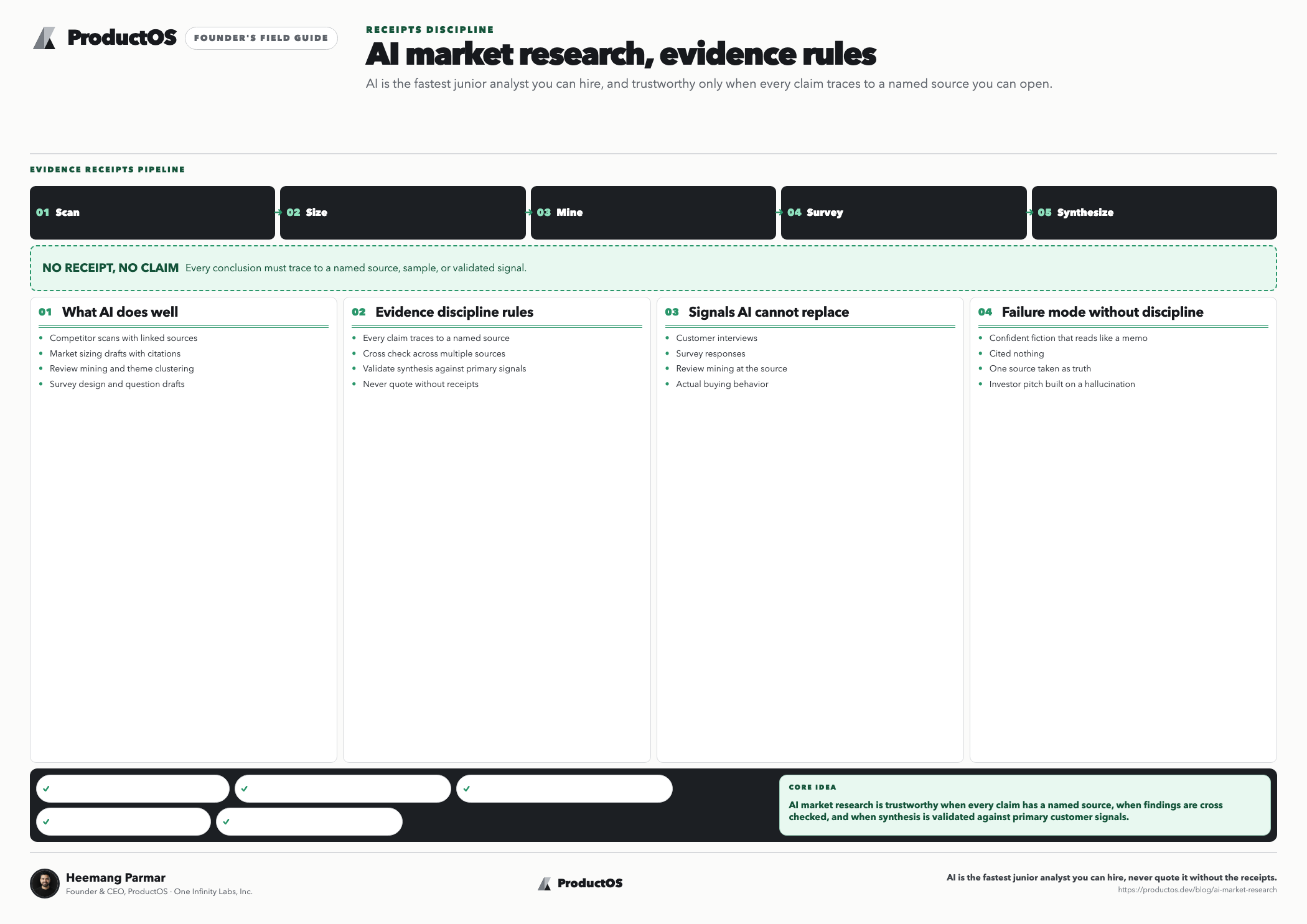
The line between the two outcomes is evidence discipline. AI research is trustworthy when every claim traces to a named source you can open, when findings are cross-checked across multiple sources instead of taken from one, and when secondary synthesis is validated against primary customer signals: surveys, interviews, reviews, and actual buying behavior.
AI is the fastest junior analyst you have ever hired. It is not a substitute for talking to customers, and it should never be quoted without its receipts.
This guide covers what AI can genuinely do in market research today, how to keep it honest, where surveys and customer signals fit, and a step-by-step workflow you can run this week. If you want to see cited, multi-source research generated as part of a product pipeline, look at the ProductOS AI market research feature first, then read on for the method behind it.
What is AI market research?
AI market research is the use of large language models and automated retrieval to collect, synthesize, and analyze market evidence: competitors, market size, customer sentiment, pricing, and trends. It replaces the manual desk-research phase of traditional research, while primary methods like interviews and surveys remain human-directed, with AI assisting on design and analysis.
The distinction that matters is secondary versus primary research. Secondary research reads what already exists: competitor sites, industry reports, review platforms, forums, filings. This is where AI is transformative, because the bottleneck was always reading speed and synthesis, and models remove both.
Primary research creates new evidence by asking real people or observing real behavior. Here AI assists at the edges, drafting questions and coding responses, but the evidence itself still has to come from actual customers.
Traditional research agencies charge five to six figures and take weeks, which is why most early-stage teams historically skipped research altogether and built on instinct.
That is the real shift in 2026: not that AI research beats a top-tier analyst firm, but that it makes real research cheap enough that skipping it is no longer defensible. A founder can now run a competitor scan, mine a thousand reviews, and draft a validation survey in one working day, before writing a product requirements document instead of after launching the wrong thing.
What can AI actually do well in market research?
AI excels at reading, structuring, and synthesizing at volume: scanning competitors, mining reviews for patterns, summarizing reports, and drafting research instruments. It is weak where evidence must be created rather than found, and where a number’s provenance matters more than its plausibility. Match the task to the strength and you avoid most failure modes.
| Research task | How AI helps | Human check required |
|---|---|---|
| Competitor analysis | Scans sites, pricing pages, changelogs, and positioning across dozens of competitors in minutes | Verify pricing and features on the live site; models cite stale pages |
| Review mining | Clusters hundreds of G2, App Store, or Amazon reviews into recurring complaints and unmet needs | Read the top quotes yourself; clusters hide intensity |
| Market sizing | Assembles TAM, SAM, and SOM estimates from cited public data | Trace every number to its source; recompute the arithmetic |
| Survey design | Drafts unbiased questions, screeners, and answer scales in minutes | Pilot with five real respondents before full send |
| Interview analysis | Transcribes, codes themes, and extracts verbatims across all sessions | Spot-check codes against raw transcripts |
| Trend synthesis | Summarizes analyst reports, news, and forum chatter into a briefing | Confirm each claim is dated and sourced, not inferred |
| Persona drafting | Turns interview and review evidence into structured personas | Ground in real quotes; discard any trait with no evidence behind it |
Notice the pattern in the right column: every check is about provenance. The model’s synthesis is usually sound; its sourcing is where errors hide.
Synthesis-heavy knowledge work is where AI assistance pays off most, and market research is close to a pure case of it. The gains are real. They just arrive with a verification tax that you must actually pay.
For the analysis-to-artifact step, purpose-built tools help more than raw chat. A user persona generator turns research evidence into structured personas, and a lean canvas generator forces sized markets and named segments into a one-page model you can argue with. Both are free and take minutes.
How do you keep AI research honest?
Require a citation for every factual claim, cross-check important claims across at least two independent sources, and never let a number into a deck unless you have opened its source. These three rules eliminate the majority of AI research failures, because the failures are almost always provenance failures, not reasoning failures.
Why do models fabricate market data?
The core risk is hallucination: a model generating plausible but false information, complete with realistic-sounding statistics and invented report names. Market research is unusually exposed to it because market claims are exactly the kind of thing models fabricate fluently.
“The global market reached $4.2 billion in 2024, growing at 11.3% CAGR” is trivially easy to generate and expensive to believe. If a figure has no named, openable source, it does not exist. Treat it that way.
The structural fix is retrieval. Systems built on retrieval-augmented generation fetch live documents first and generate answers grounded in them, which converts “the model remembers something” into “the model read something you can also read.”
Grounding does not remove the need for checks, since retrieved sources can themselves be wrong or stale, but it makes verification possible at all. Research output without retrievable sources is not research. It is prose.
What does verification actually involve?
Multi-source discipline is the second layer. Any claim that will influence a decision should survive triangulation: two or more independent sources agreeing, with the disagreement noted when they do not. Independent matters; ten articles quoting the same press release count as one source.
Date-stamping is the third layer. Markets move faster than training data, so ask when each source was published, and prefer a dated 2025 figure over an undated confident one every time.
Finally, keep the model out of the conclusion seat. AI assembles and structures evidence; you decide what it means.
The moment a synthesis says “therefore you should build X,” check whether that inference came from the evidence or from the model’s eagerness to be useful. The two are indistinguishable in tone and very distinguishable in outcome.
Tips
- Delete any statistic that arrives without a named, openable source, no matter how plausible it reads.
- Ask for the publication date of every source and prefer a dated older figure over an undated confident one.
- Treat ten articles citing the same press release as one source, not ten.
- Recompute every piece of arithmetic in a market-sizing model yourself; models transpose digits confidently.
- Keep a log of verified versus rejected claims so the next research cycle starts from clean evidence.
Why are customer signals still the primary evidence?
Because secondary research tells you what a market looked like, while customer signals tell you whether specific people will act. Reports, competitor scans, and sizing establish context. Surveys, interviews, reviews, and observed behavior establish demand. AI accelerates both, but no amount of synthesis substitutes for evidence that real customers want the thing.
Rank your evidence by how close it sits to a real decision:
- Behavior. Signups, preorders, waitlist conversion, retention, churn reasons. What people do outranks everything they say.
- Direct statements. Interviews and open-ended survey responses, in the customer’s own words, about problems they already tried to solve.
- Public complaints. Reviews and forum posts about competitors: unprompted, specific, and written by people who already paid.
- Structured survey data. Quantified attitudes and preferences, valid when sampling and question design are sound.
- Secondary synthesis. Reports, articles, and AI summaries. Context, not proof.
AI changes how you work each level without changing the ranking. For surveys, it drafts screeners and unbiased questions, then codes open-ended responses at a scale no team reads manually. For interviews, it transcribes and themes every session so nothing rots in a folder of recordings.
For review mining, it is the difference between sampling twenty reviews and clustering two thousand. The evidence stays primary; the processing becomes instant.
What is synthetic validation, and why should you avoid it?
The failure mode to avoid in 2026 is synthetic validation: asking a model to role-play your target customer and treating its answers as demand evidence. Simulated personas are useful for pressure-testing question wording or rehearsing an interview. They are not customers.
A model predicting what a busy clinic manager would say is secondary inference wearing a primary costume, and funding decisions built on it fail in the oldest way possible: nobody actually wanted it. This is where founders get burned most often, because the synthetic answers are always encouraging.
What does an AI market research workflow look like, step by step?
Start from the decision you need to make, gather cited secondary evidence, mine competitor reviews, size the market with traceable numbers, then validate with primary signals before committing to a build. The sequence matters: secondary research shapes the questions, primary research answers them, and the synthesis feeds directly into your spec.
- Define the decision. Write the question the research must answer: “Should we build X for segment Y?” Research without a decision attached becomes a reading hobby.
- Run a cited competitor scan. Have AI map direct and indirect competitors, their pricing, positioning, and gaps, with a source link per claim. Verify the five that matter on their live sites.
- Mine the reviews. Cluster competitor reviews into recurring complaints. The complaints are your opportunity list, in the customer’s own words.
- Size the market with receipts. Build TAM, SAM, and SOM from cited public data, recompute the arithmetic yourself, and flag every assumption.
- Draft and pilot a survey. AI drafts the instrument; five real respondents pilot it; then it goes to the segment. Behavior questions over opinion questions.
- Talk to ten customers. AI preps the guide and codes the transcripts. You do the listening.
- Synthesize into artifacts. Fold everything into a lean canvas, personas, and then a PRD, so the evidence lands in the document that drives the build. An AI PRD generator that accepts research context closes this loop in one step, and spec-driven development is the argument for why that handoff matters.
Steps one through four are a single day with AI. Steps five and six take a week because humans answer on human time, and that week is the highest-value part of the process.
Teams that skip straight from a competitor scan to a build have done AI-accelerated guessing, not research. This workflow is also the research backbone of the broader AI product management stack, where the same evidence feeds prioritization and roadmaps, not just the initial build decision.
A worked sizing example
Say you are sizing appointment software for independent physiotherapy clinics. Hypothetical numbers, real method:
- TAM. Count the clinics from a government business registry or industry association census, then multiply by a realistic annual price. If the registry lists 40,000 clinics and your price is $1,200 per year, TAM is $48 million, not “the healthcare software market.”
- SAM. Cut to the segment you can actually serve: solo and two-person clinics in your launch country that already book online. If that is 12,000 clinics, SAM is $14.4 million.
- SOM. Estimate what your channel can win in three years. Two percent of SAM is roughly $290,000 in annual revenue, and now the pitch conversation is honest.
Every input here is checkable: the registry count, the price, the segment cut. That is the property to demand from any AI-assembled sizing model, and the verification pass takes five minutes.
When is the research enough?
Research is a means to a decision, so stop when the decision is stable. A practical bar before committing to a build:
- You can name three direct competitors and state, in one sentence each, why their customers complain.
- Your market size survives a bottom-up recomputation with sources you opened yourself.
- At least ten target customers described the problem in their own words, unprompted by your pitch.
- You have one behavioral signal, a waitlist, preorders, or a pilot commitment, not just polite interest.
- The riskiest assumption in your lean canvas is written down, with the evidence for and against it.
If any line fails, that line is your next research task. If all five hold, more research is procrastination with citations.
How does ProductOS do market research?
ProductOS runs research as a pipeline stage, not a chat session. In the Discover stage, a dedicated Research Agent produces the market analysis: competitors, positioning, sizing, and customer evidence, grounded in retrieved sources rather than model memory.
It is one of ten specialized agents that share a single project context across Ideate, Discover, Define, Design, and Develop, so the findings do not die in a document. The PRD Agent writes requirements with the research in context, the Design and Build agents inherit the same evidence, and the product that ships traces back to the market case that justified it.
That continuity is the point. Most teams’ research and building live in different tools and go stale separately. Here they are the same pipeline, which is what AI market research on ProductOS is built around; agentic product development covers the full pattern.
Frequently asked questions
Can AI do market research?
Yes, for the secondary half. AI handles competitor analysis, review mining, market sizing from public data, trend synthesis, and research instrument design faster than any human team, provided every claim is cited and verified. It cannot replace primary research: real surveys, interviews, and behavioral evidence still require real customers. The strongest results come from AI doing the reading and structuring while humans do the asking and deciding.
How accurate is AI market research?
As accurate as its sourcing discipline. Grounded, retrieval-based research with citations you verify is reliable enough to base decisions on. Ungrounded chat output is not, because models fabricate plausible statistics, growth rates, and even report titles with complete confidence. The practical rule: any number without a named, openable source gets deleted, and any decision-critical claim needs two independent sources. Accuracy is a property of your process, not of the model.
What is the best AI tool for market research?
It depends on where the research needs to land. General assistants with web retrieval suit ad-hoc questions. Purpose-built research platforms suit standing competitive intelligence. If the research exists to drive a product build, an integrated pipeline is stronger than a standalone tool, because findings flow directly into the PRD and design instead of a slide deck. Whatever you pick, citation support is the non-negotiable feature.
Can AI replace customer surveys and interviews?
No. AI can draft survey questions, simulate pilot respondents to catch confusing wording, transcribe interviews, and code responses at scale, which cuts the effort of primary research dramatically. But synthetic respondents are inference, not evidence. A model role-playing your customer tells you what is statistically plausible, not what your actual market will pay for. Use AI around the survey, never instead of it.
How do I size a market with AI?
Ask for a TAM, SAM, and SOM build where every input is a cited public figure: government data, company filings, published industry reports. Then open each source, confirm the number and its date, and recompute the arithmetic yourself. Prefer bottom-up sizing, price times reachable buyers, over quoting a headline market figure. AI makes assembling the model fast; the verification pass is what makes it usable.
What is an AI hallucination in research?
A hallucination is output that is fluent, specific, and false: an invented market size, a fabricated survey result, a citation to a report that does not exist. It happens because language models generate likely-sounding text rather than looking facts up, unless they are connected to retrieval. In research the danger is elevated because fabricated numbers look identical to real ones. The defense is structural: retrieval-grounded tools, mandatory citations, and opening every source.
How does ProductOS keep research findings connected to the build?
Through shared context. The Research Agent’s cited findings live in the same project context used by the PRD, Design, and Build agents, so requirements are written with the market evidence in view rather than from memory or a pasted summary. Nothing forces you to build what the research says, but the evidence and the product stay in one pipeline, which removes the usual gap where research is finished, filed, and forgotten.
Run the research before the build
The teams shipping the right products in 2026 are not the ones with the biggest research budgets. They are the ones who stopped choosing between rigor and speed, because AI removed the trade-off: cited secondary research in a day, primary signals in a week, and every finding feeding the spec.
Run one cycle of the workflow above on your current idea and see what it changes. Or let the pipeline run it for you: see how AI market research works on ProductOS, or start building free and watch the Discover stage produce the evidence before a single screen is designed.
CS engineer and IIM Lucknow MBA. Built products across enterprise and AI for 10+ years. Founded ProductOS to give every PM and founder the leverage of a full product team. Writes about AI product development, PRDs, and building with agents.