8 PRD examples from real products, with templates

The fastest way to write a better PRD is to steal the shape of one that already worked. Below are 8 PRD examples from the kinds of products teams actually ship, a new feature, a mobile app, an API, an AI feature, and more, each with what its PRD has to emphasize and a reusable mini-template you can paste and fill in. A good PRD is not one fixed template you apply everywhere. It bends to the product: an API PRD lives or dies on its contract; an AI feature PRD lives or dies on its failure modes.
If you want the underlying format first, read the product requirements document guide. This post is the pattern library of concrete prd examples you can adapt today.
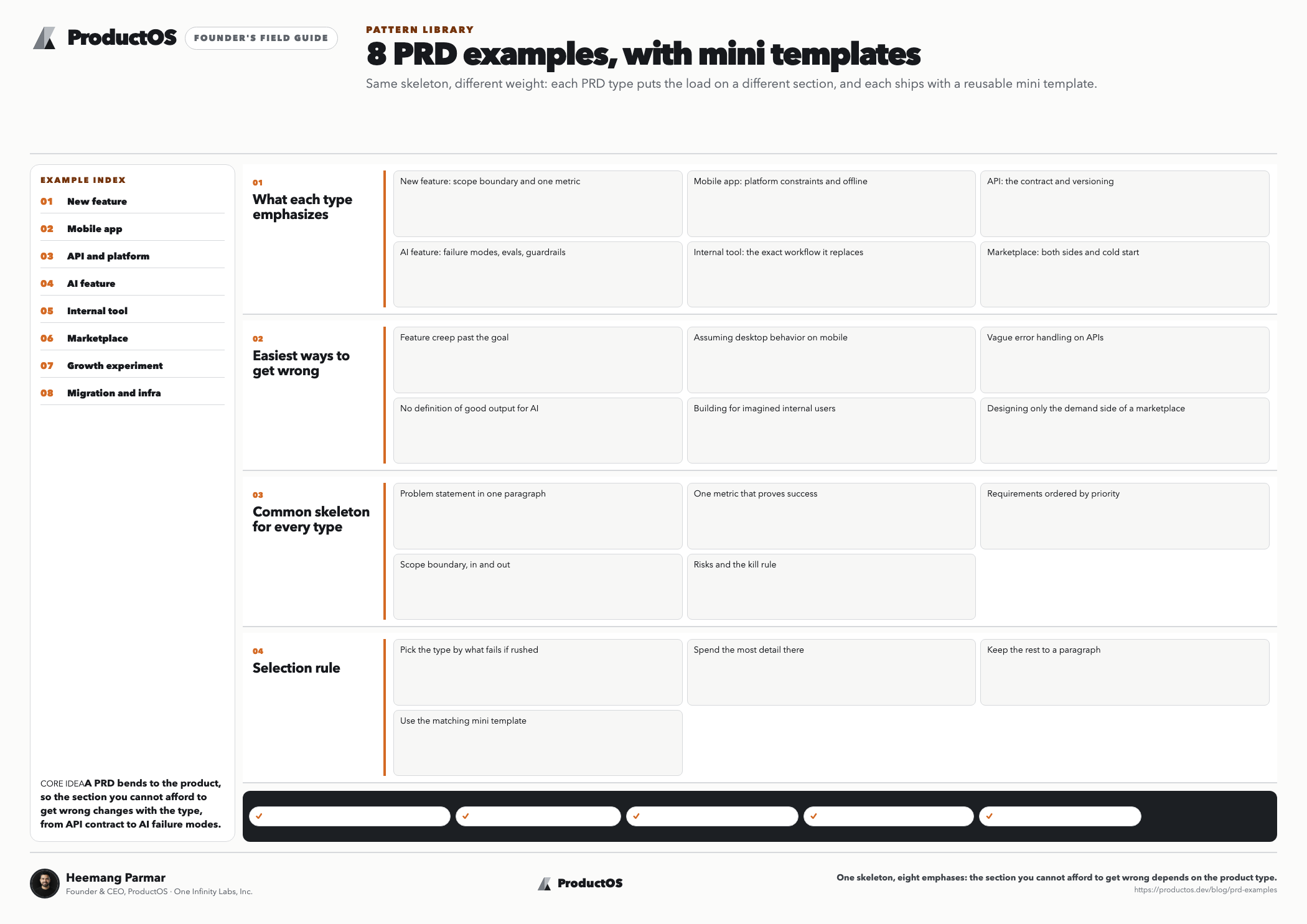
The 8 PRD examples at a glance
Same skeleton every time, problem, one metric, requirements, scope, risks. What changes is the section you cannot afford to get wrong. Here is where each type puts its weight.
| PRD type | What it emphasizes most | Easiest thing to get wrong |
|---|---|---|
| New feature | Scope boundary + one metric | Feature creep past the goal |
| Mobile app | Platform constraints, offline, permissions | Assuming desktop behavior |
| API / platform | The contract and versioning | Vague error handling |
| AI feature | Failure modes, evals, guardrails | No definition of “good output” |
| Internal tool | The exact workflow it replaces | Building for imagined users |
| Marketplace | Both sides + cold start | Designing only the demand side |
| Growth experiment | Hypothesis + kill criteria | Shipping without a decision rule |
| Migration / infra | Non-functional reqs + rollback | No measurable “done” |
8 PRD examples, with a mini-template for each
1. A new feature in an existing product
The most common PRD, and the one where scope discipline matters most. The whole document exists to draw a line around what ships this release. Emphasize a single success metric and an explicit out-of-scope list, because a feature inside a mature product has a hundred tempting adjacencies.
Template: Problem: [who hits it, when, what it costs]. Goal: move [metric] from [x] to [y] by [date]. Must-have: [1-3 requirements]. Out of scope: [the tempting things you are not doing]. Open question: [the one unknown that could change the plan].
2. A net-new mobile app
Here the PRD carries context a web feature never has to: OS differences, offline behavior, permissions, notifications, and app-store review. Emphasize the platform constraints and the first-session experience, because on mobile you get one launch to earn the second.
Template: Platforms: [iOS / Android / both, min versions]. Core loop: [the one thing users do repeatedly]. Offline behavior: [what works with no network]. Permissions requested: [each one, and why]. First session: [what a new user must reach in under 60 seconds].
3. An API or developer platform
An API PRD is a contract. Its users are engineers, and its success metric is often time-to-first-successful-call. Emphasize the interface precisely: endpoints, request and response shapes, auth, rate limits, error codes, and versioning. Vague error handling is the classic miss, so specify what failure looks like, not just the happy path.
Template: Consumer: [who integrates, for what]. Endpoints: [verb + path + purpose]. Auth: [method]. Errors: [status codes + messages for the top failures]. Versioning + deprecation policy: [how breaking changes ship]. Success metric: [time to first successful call].
4. An AI-powered feature
The PRD type most teams get wrong in 2026, because they write it like a deterministic feature. An AI feature is probabilistic, so the PRD must define what “good output” means, how you measure it, and what happens when the model is wrong. Emphasize evaluation criteria, guardrails, and failure modes over UI detail.
Template: Job: [what the AI does for the user]. Good output looks like: [criteria you can grade]. Eval set: [examples + how you score them]. Failure modes: [hallucination, refusal, latency] and the fallback for each. Guardrails: [what it must never do]. Cost/latency budget: [per request].
Because these requirements now feed coding agents directly, precision pays off twice. See AI agents in production for the failure-mode thinking this section needs.
5. An internal tool
Internal tools have a captive, known audience, which flips the PRD. You are not guessing at user needs, you can go watch them work. Emphasize the exact current workflow the tool replaces and the adoption path, because internal tools fail on adoption, not features. If the ops team keeps using the spreadsheet, you built the wrong thing.
Template: Team + workflow today: [the current steps, including the spreadsheet]. Pain: [where it breaks or wastes time]. New flow: [the replacement, step by step]. Adoption plan: [who champions it, how you cut over]. Success metric: [time saved or errors avoided].
6. A two-sided marketplace
A marketplace PRD designs two products at once, supply and demand, plus the cold-start problem of having neither yet. Emphasize both sides and the liquidity mechanic that gets the first transactions happening. The classic failure is a beautiful buyer experience with hand-waving about where supply comes from.
Template: Supply side: [who lists, why, first-listing flow]. Demand side: [who buys, why, first-purchase flow]. Liquidity: [how the first N matches happen, seeded or organic]. Trust + safety: [reviews, disputes, payments]. Success metric: [completed transactions, not signups].
7. A growth experiment
Short by design. Its job is to state a falsifiable hypothesis and a decision rule before you build, so the result cannot be argued away later. Emphasize the single metric and the kill criteria. If you cannot say in advance what result would make you stop, it is not an experiment, it is a launch with extra steps.
Template: Hypothesis: we believe [change] will improve [metric] because [reason]. Test: [what ships to whom, for how long]. Ship it if: [threshold]. Kill it if: [threshold]. One metric: [the number that decides]. Guardrail metric: [what must not get worse].
8. A platform migration or infrastructure change
A technical PRD with few visible features and high stakes. The requirements are mostly non-functional: performance, reliability, cost, and a safe rollback. Emphasize measurable done-criteria and the rollback plan, because “we migrated the database” is not a finish line anyone can verify.
Template: Why now: [the cost or risk of the current state]. Non-functional targets: [latency, uptime, cost after]. Migration steps: [phased, with checkpoints]. Rollback: [how to revert at each phase]. Done means: [the measurable state you are migrating to]. Risk: [the worst case + mitigation].
How to use these PRD examples
Pick the pattern closest to what you are building, copy its mini-template, and fill the blanks in your own words. Then pressure-test the emphasized section hardest, because that is where this PRD type usually fails. A marketplace PRD with a thin supply side, or an AI PRD with no eval set, is a rewrite waiting to happen.
For a full section-by-section starting point, grab the PRD template. And for a first draft in under a minute from a two-line idea, a PRD generator will scaffold any of these eight types, then you own the judgment on the emphasized part: the metric, the scope line, the failure modes.
Frequently asked questions
What is the best PRD example to learn from?
The one closest to what you are shipping, because emphasis differs so much by product type. Adding to an existing product? Study the new-feature example and its scope discipline. Building an AI feature? The eval-and-failure-mode structure matters far more than any generic template.
Are these PRD examples the same as a template?
Not quite. A template is the empty skeleton you fill in; these examples show how that skeleton bends for different products and which section carries the weight each time. Use the examples to understand the emphasis, then use the PRD template as the blank you actually write into.
How detailed should a PRD example be?
Detailed enough to align the team and remove guessing, and no more. For most features that is one to three pages. The mini-templates above are deliberately compact because length is not rigor, and the discipline of keeping it short is what forces the hard decisions.
Do PRD examples change when you build with AI coding agents?
Yes, in one important way: requirements now have to be precise and testable because an agent will resolve any ambiguity for you, rarely the way you intended. The AI-feature example above is written for exactly this, define good output and failure modes so generated code has a target. This is why spec-driven development keeps gaining ground.
Can I mix these PRD types?
Often you have to. A net-new AI mobile app touches three of these at once. Keep the shared skeleton and pull in the emphasized section from each relevant type: the eval set from the AI example, offline and permissions from mobile, a single metric from the feature example.
CS engineer and IIM Lucknow MBA. Built products across enterprise and AI for 10+ years. Founded ProductOS to give every PM and founder the leverage of a full product team. Writes about AI product development, PRDs, and building with agents.