The PRD template we use at ProductOS (free)

A good PRD template does one job: it forces you to make the decisions that matter before anyone writes code. Not to document features, but to record what you are building, for whom, and how you will know it worked. Below is the exact PRD template we use at ProductOS, the sections it contains, and how to fill each one without turning it into a 20-page document nobody reads.
You can copy the structure straight into a doc, or generate a filled draft with our free PRD generator. Either way, the shape is what matters.
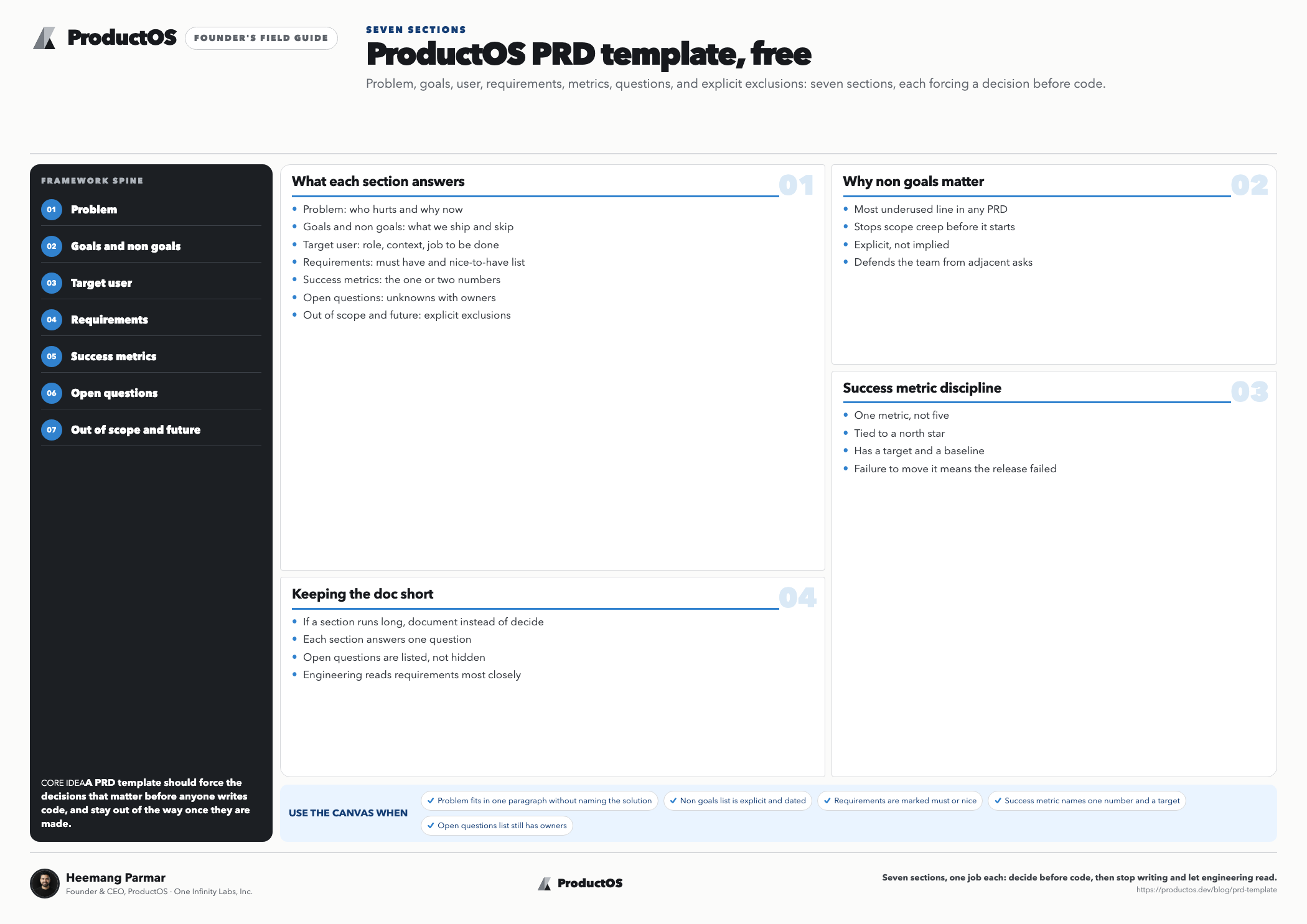
The PRD template, section by section
Seven sections, in order. Each one answers a single question, and each one should be short. If a section runs long, you are documenting instead of deciding.
1. Problem
What problem are we solving, and for whom? One paragraph. Name the user, the pain, and why it matters now. If you cannot state the problem without describing your solution, you do not understand the problem yet.
2. Goals and non-goals
What does this release achieve, and just as important, what does it deliberately not do? Non-goals are the most under-used line in any PRD. They are how you stop scope creep before it starts.
3. Target user
Who is this for, specifically? A role, a context, a job they are trying to get done. If you have a user persona, link it here. Vague users produce vague products.
4. Requirements
What must the product do? Write these as user stories or plain capability statements, ordered by priority. Mark each as must-have or nice-to-have. This is the only section that should be a list, and it is the one engineering reads most closely.
5. Success metrics
How will you know it worked? Name the one or two numbers that move if this succeeds. A release without a success metric is a feature you cannot evaluate. If you need a primary metric, our guide to the north star metric covers how to pick one.
6. Open questions
What do you still not know? Listing the unknowns is not a weakness, it is how you avoid pretending a guess is a decision. These become the questions design and engineering resolve before the build.
7. Out of scope and future
What is explicitly parked for later? This keeps the current release honest and gives the next one a starting point.
How to actually use the template
- Fill it before you design, not after. A PRD written after the mockups is documentation, not a decision record. The whole point is that design and code are built against it.
- Keep every section to a few lines. The discipline is in the brevity. A short PRD that names the real decisions beats a long one that hides them.
- Get the outline approved first. Agree on the problem, goals, and requirements before writing detail. It is far cheaper to change your mind at the outline stage.
- Treat it as the source of truth. When design or code disagrees with the PRD, one of them is wrong, and the PRD is where you resolve it. This is the core idea behind spec-driven development.
Why we built the template this way
Most product specs fail for the same reason: they document features instead of decisions. Teams spend days writing a long PRD that nobody reads, then build the wrong thing anyway. This template is deliberately short because its job is to force clarity, not to be comprehensive. If you want the full method behind it, read our guide to writing a product requirements document.
Frequently asked questions
What should a PRD template include?
At minimum: the problem, goals and non-goals, the target user, prioritized requirements, success metrics, open questions, and what is out of scope. Each section answers one question and should stay short. The value is in the decisions it forces, not in the length.
How long should a PRD be?
As short as it can be while still naming the real decisions, usually one to three pages. A long PRD tends to hide the important choices in detail. If a section runs long, you are documenting instead of deciding.
Is there a free PRD template?
Yes. The seven-section structure above is free to copy, and you can generate a filled draft with the ProductOS PRD generator. The structure matters more than the tool.
What is the difference between a PRD and a spec?
A PRD captures the product decisions: the problem, the users, the requirements, and how success is measured. A technical spec translates those into implementation detail. In spec-driven development the approved PRD is the source of truth the design and the code are built against.
CS engineer and IIM Lucknow MBA. Built products across enterprise and AI for 10+ years. Founded ProductOS to give every PM and founder the leverage of a full product team. Writes about AI product development, PRDs, and building with agents.