A product roadmap template that survives real teams

Here is the only product roadmap template that survives contact with a real team: three columns labeled Now, Next, and Later, where every item is a customer outcome you can measure, not a feature with a date attached. No Gantt chart. No quarter-by-quarter feature list you will quietly abandon by week three. If your roadmap has hard dates past the current quarter, you are not planning, you are writing fiction.
I have shipped enough products to know how roadmaps die. They rot because someone promised a feature to a customer, the date slipped, trust broke, and the whole document became something people stopped believing. The fix is not a better tool. It is a format that assumes you will be wrong about timing, and organizes around what you are trying to achieve instead.
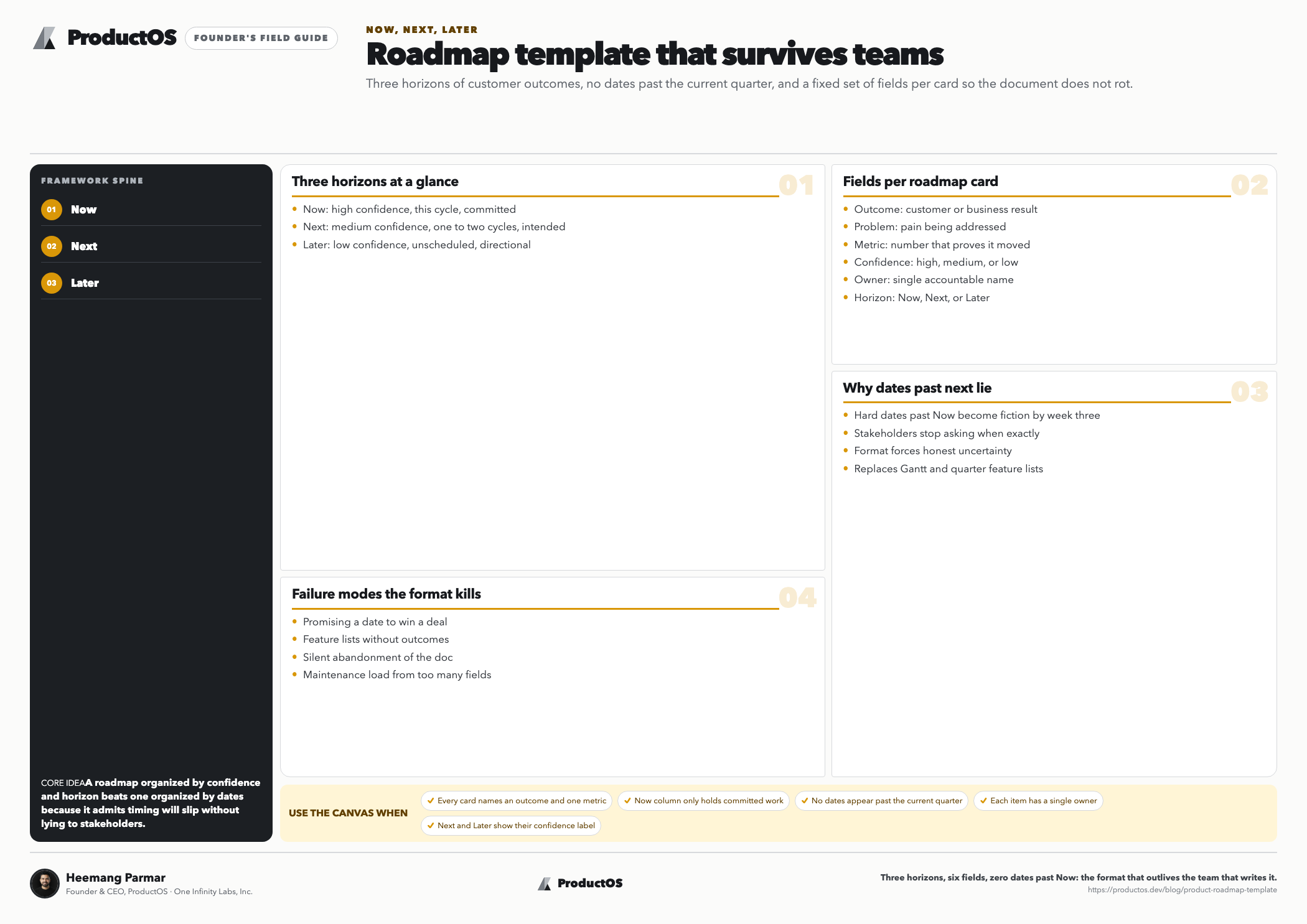
The product roadmap template, in full
Copy this. It is three horizons and a small set of fields per item. The Now column holds work that is committed and in flight. Next holds what you have validated enough to build after Now clears. Later holds bets you believe in but have not scoped. That is the entire structure.
| Horizon | Confidence | Time sense | Commitment level | What lives here |
|---|---|---|---|---|
| Now | High | This cycle (weeks) | Committed, promised | Scoped, staffed, in build |
| Next | Medium | 1-2 cycles out | Intended, not promised | Validated problems, rough scope |
| Later | Low | Unscheduled | Directional | Bets, big ideas, research |
The magic is in the honesty of the columns. You are allowed to be certain about Now and vague about Later. Stakeholders stop asking “when exactly” because the format tells them the answer is “we do not know yet, and pretending we do would be lying.”
The fields every roadmap item needs
A column label is not a roadmap. Each card in your product roadmap template carries a small, fixed set of fields. Keep it to these. More fields means more maintenance, and maintenance is where roadmaps go to die.
- Outcome: the customer or business result, written as a change in behavior or metric. “Reduce time-to-first-value from 9 minutes to under 3” beats “Onboarding v2.”
- Problem: one sentence on why this matters and who feels the pain. If you cannot name the user, it is not ready for Now or Next.
- Signal: the evidence. Support tickets, churn interviews, usage data, a revenue number. No signal, no promotion out of Later.
- Metric moved: which top-line number this ladders up to. Tie it to your north star metric so the roadmap and the strategy cannot drift apart.
- Confidence: high, medium, or low. This is not decoration. It gates which horizon the item is allowed to sit in.
- Owner: one name. Shared ownership is no ownership.
Notice what is missing: a date, an estimate in story points, a design mockup. Those live downstream in the spec, not on the roadmap. When an item graduates to Now, it earns a product requirements document where the real detail goes. The roadmap stays a strategy artifact, thin and readable in thirty seconds.
Now / Next / Later versus dated roadmaps
People push back on outcome-based roadmaps because leadership “wants dates.” Fair. Here is the tradeoff, laid out plainly, so you can choose with eyes open.
| Approach | Best for | Breaks when | Maintenance cost |
|---|---|---|---|
| Now / Next / Later | Fast-moving teams, discovery-heavy work | Contracts genuinely need fixed dates | Low |
| Outcome-based (goals) | Aligning many teams to strategy | Teams cannot connect outcomes to daily work | Medium |
| Timeline / Gantt | Compliance, hardware, fixed launches | Any assumption changes, which is always | High |
Most software teams should run Now / Next / Later as the default and layer outcomes on top. Reserve timelines for the rare commitment that is truly date-bound, a regulatory deadline or a partner launch, and even then, only date the single milestone, not the path to it.
How to keep the roadmap from rotting
A roadmap is a living document or it is a lie. The rot sets in when the document and reality quietly diverge and nobody reconciles them. Prevent that with a small ritual, not a big process.
- Review it every cycle, on a calendar, forever. Fifteen minutes at the start of each sprint or two-week cycle. What shipped moves off Now. What earned enough signal gets promoted. What lost relevance gets killed without ceremony.
- Make promotion earn its way. Nothing jumps from Later to Now. It moves Later to Next to Now, gaining a field of evidence at each step. This one rule stops the “loudest stakeholder” from bulldozing your plan.
- Delete aggressively. A Later column with forty items is a graveyard, not a roadmap. If it has sat untouched for two review cycles with no new signal, archive it. You can always resurrect a good idea.
- Cap Now. A team can hold three to five active outcomes, not twelve. If Now is overflowing, you are not prioritizing, you are hoarding. Force the cut.
- Write the “why we are not” list. Keep a visible list of things you deliberately said no to and why. It kills the same debate resurfacing every month and shows stakeholders you heard them.
The teams whose roadmaps survive are not more disciplined about predicting the future. They are more disciplined about updating when the future arrives. Treat the roadmap as a bet ledger you settle every two weeks, and it stops being a promise you break.
Frequently asked questions
What is the best product roadmap template format?
For most software teams, Now / Next / Later beats dated timelines. It communicates confidence honestly, survives changing priorities, and takes minutes to maintain. Use a dated timeline only for genuinely fixed commitments like regulatory deadlines or partner launches, and date only the milestone, not the whole path to it.
Should a product roadmap have dates?
Only for the current cycle, and only for work already committed. Past the immediate horizon, dates create false certainty and become broken promises. Communicate confidence and sequence instead. Say what is committed now, what is intended next, and what is directional later.
How often should you update a product roadmap?
Every cycle, meaning every one to two weeks. A short recurring review where you move shipped work off, promote items that earned evidence, and delete what went stale is what keeps a roadmap trustworthy. A roadmap reviewed quarterly is already out of date by week three.
Who owns the product roadmap?
The product manager owns the document and the prioritization, but every item needs one named owner accountable for its outcome. Leadership sets strategy and constraints, engineering informs feasibility, but a roadmap edited by committee turns into mush. One owner per item, one owner for the whole.
What is the difference between a roadmap and a backlog?
A roadmap is a strategy artifact about outcomes and direction, readable in thirty seconds. A backlog is an execution list of scoped tasks. The roadmap says what you are trying to achieve and roughly when; the backlog and the spec say exactly how. Keep them separate or the roadmap drowns in detail.
CS engineer and IIM Lucknow MBA. Built products across enterprise and AI for 10+ years. Founded ProductOS to give every PM and founder the leverage of a full product team. Writes about AI product development, PRDs, and building with agents.