11 AI tools every product manager should use in 2026

The best AI tools for product managers in 2026 are the ones that compress the boring parts of the job: research synthesis, PRD drafting, prototyping, analytics, and meeting notes. My shortlist is ChatGPT, Claude, Perplexity, the ProductOS PRD Generator, Notion AI, Granola, Figma Make, v0, ProductOS, Dovetail, Amplitude, and Gamma. Below I break down what each one is actually good for, what it costs, and where it fits in a real PM workflow.
I run product at an AI company, so I use most of these every week. The list is opinionated. I skipped the tools that demo well and die in real work, and I focused on the stack that moves an idea from a fuzzy customer signal to a shipped feature.
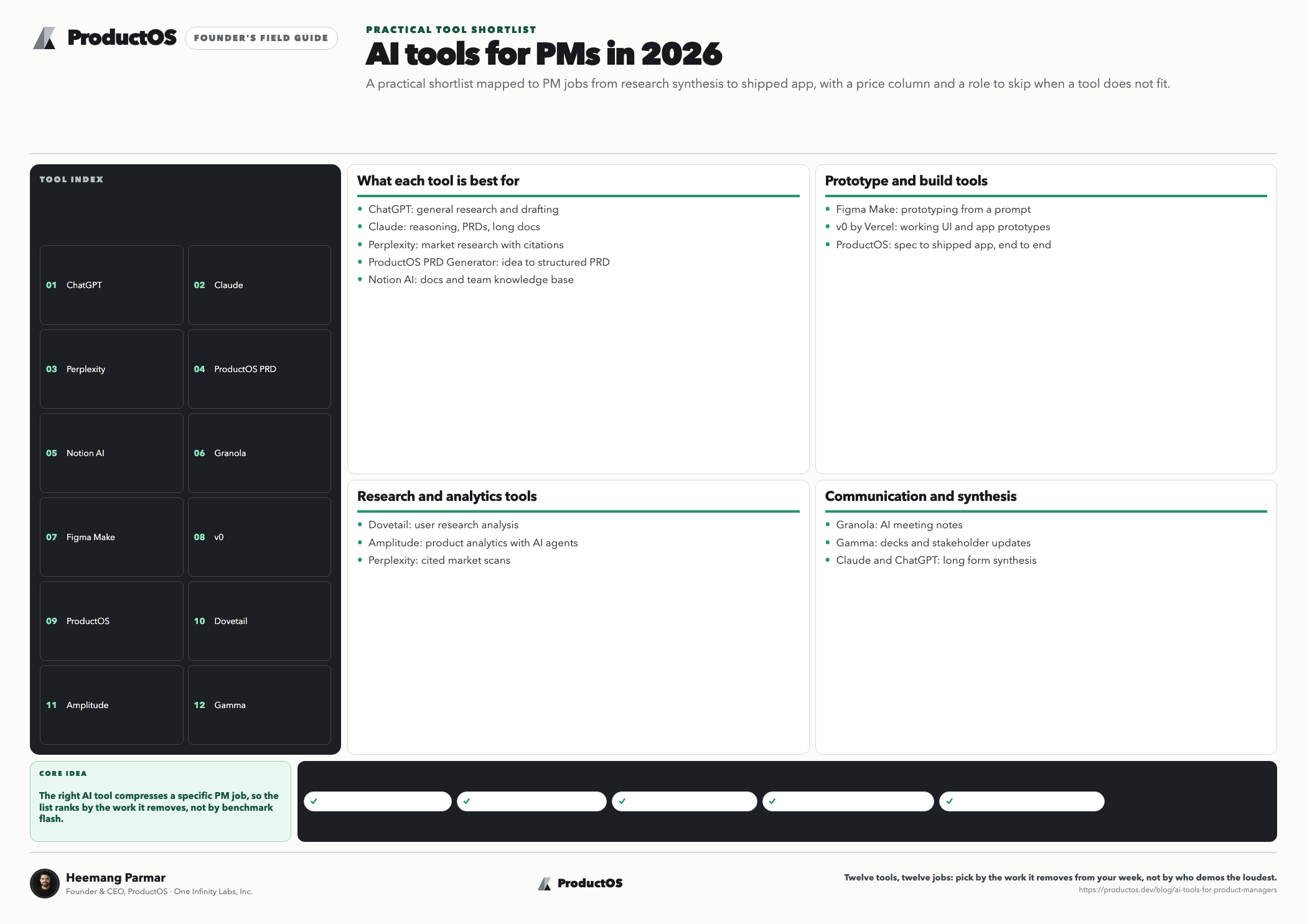
The AI tools for product managers, at a glance
Here is the full comparison so you can scan before you read. Prices are current as of July 2026 and reflect monthly billing unless noted.
| Tool | Best for | Free tier | Paid from |
|---|---|---|---|
| ChatGPT | General research and drafting | Yes | $20/mo (Plus) |
| Claude | Reasoning, PRDs, long documents | Yes | $20/mo (Pro) |
| Perplexity | Market research with citations | Yes | $20/mo (Pro) |
| ProductOS PRD Generator | Turning an idea into a structured PRD | Yes | Free |
| Notion AI | Docs and team knowledge base | Basic only | $20/user/mo (Business) |
| Granola | AI meeting notes | Yes (25 notes) | $14/user/mo |
| Figma Make | Prototyping from a prompt | Yes | $12/editor/mo |
| v0 by Vercel | Working UI and app prototypes | Yes ($5 credits) | $20/mo (Premium) |
| ProductOS | Spec to shipped app, end to end | Yes (30 credits) | $20/mo (Pro) |
| Dovetail | User research analysis | Yes (3 users) | ~$39/editor/mo |
| Amplitude | Product analytics with AI agents | Yes | $49/mo (Plus) |
| Gamma | Decks and stakeholder updates | Yes (400 credits) | $10/user/mo (Plus) |
Research and discovery
Perplexity is my first stop for market research. It answers with linked sources, so I can verify a competitor claim or a market-size number instead of trusting a hallucination. Pro is $20 per month, and the free tier is enough to try it. If you do this a lot, my longer piece on AI market research goes deeper on prompts and pitfalls.
ChatGPT and Claude both sit at $20 per month for their Pro tiers, and both have real free plans. I reach for ChatGPT for fast drafting, brainstorming, and quick data cleanup. I reach for Claude when I need it to reason over a long document, a messy transcript, or a spec without losing the thread. Most PMs I know pay for one and use the free version of the other. Try both before you commit.
Writing PRDs and specs
This is where AI saves me the most time. A blank PRD is a tax on momentum. The ProductOS PRD Generator takes a rough idea and returns a structured draft with problem statement, goals, user stories, and success metrics already scaffolded. It is free, and it gives you a real starting point instead of a staring contest.
I still finish the draft in a general model. I paste the scaffold into Claude, feed it the customer context, and have it pressure-test the edge cases I missed. If you want the anatomy of a good spec before you generate one, read our guide on the product requirements document.
Prototyping without waiting on engineering
The biggest shift in the PM job over the last two years is that you can now build a clickable prototype yourself. Two tools do this well.
Figma Make turns a prompt into an interactive prototype and lives inside the design tool your team already uses. It is included with a Full seat on the Professional plan at $12 per editor per month, though heavy AI usage can add credit overages. v0 by Vercel goes further and produces real, deployable UI code. The free plan ships with $5 of monthly credits, and Premium is $20 per month. Use Figma Make when you want a design artifact, and v0 when you want something closer to working software.
ProductOS sits a layer up from both. It is the AI operating system for product development, carrying one project from idea and spec through design to a shipped web, mobile, or desktop app rather than stopping at the prototype. It is model-agnostic, so you build with Claude, GPT, or Gemini under the hood. The free Hobby tier includes 30 credits a month with no card, and Pro is $20 per month for 100 credits. Reach for it when you want the whole path in one place instead of stitching a spec tool, a design tool, and a build tool together.
Understanding users and the numbers
Dovetail is the research repository my team trusts. It transcribes interviews, tags themes with AI, and surfaces patterns across dozens of calls that no human would catch by hand. The free tier covers three users, and paid editors start around $39 per month.
Amplitude handles the quantitative side. Its 2026 lineup ships AI agents that monitor dashboards, review sessions, and flag anomalies, so you spend less time building funnels and more time acting on them. The free Starter plan is genuinely usable, and the Plus tier starts at $49 per month.
Notes, docs, and stakeholder updates
Granola is the meeting notes tool I recommend most often. It records, transcribes, and summarizes calls without a bot joining the meeting, then lets you ask questions about what was said. The free plan caps history at 25 notes, and Business is $14 per user per month.
Notion AI keeps your specs, roadmaps, and research in one searchable place, and its agents can draft and update pages for you. Full AI now lives in the Business plan at $20 per user per month. Gamma rounds out the stack for the part of the job nobody enjoys: the stakeholder deck. It builds a clean presentation from a prompt or an existing doc, with a free tier and Plus at $10 per user per month.
How to actually pick your stack
Do not buy all of them. Pick one tool per stage of your workflow and learn it well. A lean, high-leverage stack for most PMs looks like this: Claude or ChatGPT for thinking and drafting, Perplexity for research, the PRD Generator for specs, v0 or Figma Make for prototypes, Granola for notes, and whatever analytics tool your company already runs.
The tools change every quarter, but the principle does not. AI is best at removing the friction between having an idea and testing it. If you want the strategic view on how this reshapes the role, read our companion piece on AI for product managers.
Frequently asked questions
What is the best AI tool for product managers?
There is no single best tool, because the PM job spans research, specs, prototyping, and analytics. If you can only pay for one, a general model like Claude or ChatGPT at $20 per month covers the most ground. Pair it with a free research tool and a free PRD generator to build a strong baseline stack.
Are free AI tools good enough for product managers?
For many PMs, yes. ChatGPT, Claude, Perplexity, Granola, and the ProductOS PRD Generator all have usable free tiers. You will hit limits on usage or history as you scale, but you can run a real workflow before paying a cent.
Can AI write a complete PRD on its own?
AI can produce a strong first draft in minutes, but it cannot replace your judgment on priorities, trade-offs, and customer context. Use a tool like the PRD Generator to scaffold the structure, then refine the details yourself. The goal is to skip the blank page, not to skip the thinking.
How much should a PM budget for AI tools per month?
A capable stack costs between $20 and $80 per month for an individual, depending on how many paid tiers you need. Start with one $20 general model, add tools only when you feel a real bottleneck, and let your company cover team-wide analytics and research platforms.
Will AI tools replace product managers?
No. AI removes busywork and speeds up execution, but it does not decide what to build or why. The PMs who win are the ones who use these tools to spend more time with customers and less time on documents.
CS engineer and IIM Lucknow MBA. Built products across enterprise and AI for 10+ years. Founded ProductOS to give every PM and founder the leverage of a full product team. Writes about AI product development, PRDs, and building with agents.