How to write a PRD: the complete 2026 guide

To write a PRD, define the problem and who has it, set one measurable goal, describe the solution as user-facing requirements and flows, list what is out of scope, and name the open questions. A product requirements document is not a spec dump or a wishlist. It is the shortest possible artifact that gets a team aligned on what to build and why, so engineering and design can move without guessing.
Here is how to write a PRD in 2026, step by step, including how to use AI without letting it bury you in filler. If you want the deeper reference on the format itself, read the product requirements document guide. This post is the practical how-to.
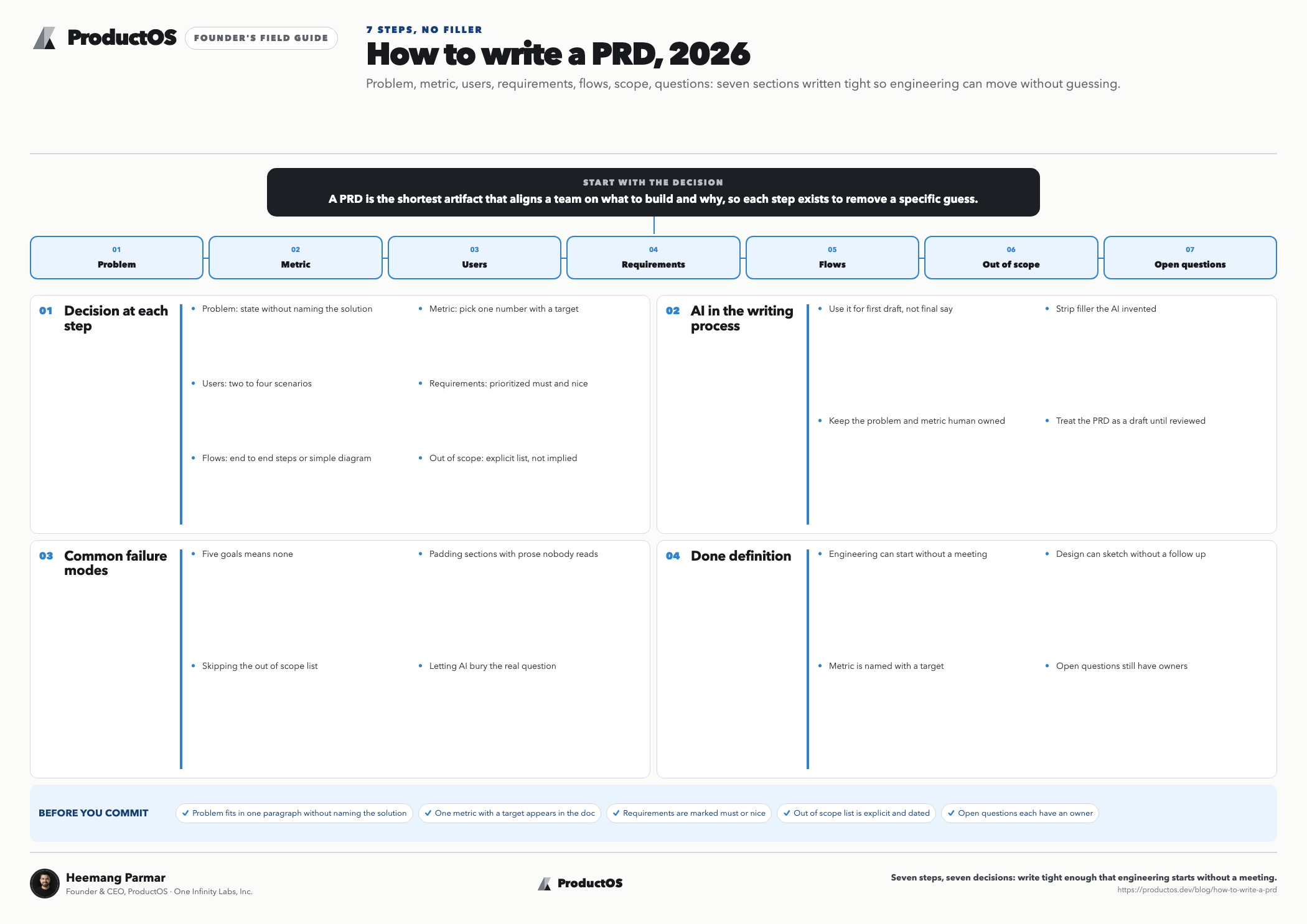
The sections a PRD actually needs
Before the steps, here is the skeleton. Most bad PRDs fail because they either skip half of these or pad them with prose nobody reads. Keep each one tight.
| Section | Answers | Keep it to |
|---|---|---|
| Problem and context | Who hurts, and why now? | 1 short paragraph |
| Goal and success metric | How will we know it worked? | 1 metric + target |
| Users and use cases | Who is this for, in what moment? | 2-4 scenarios |
| Requirements | What must it do? | A prioritized list |
| User flows | How does it work end to end? | Steps or a simple diagram |
| Out of scope | What are we deliberately not doing? | A bullet list |
| Open questions and risks | What could sink this? | A living list |
How to write a PRD in 7 steps
Start with the problem, not the feature. Write one paragraph on who has the problem, when they hit it, and what it costs them today. If you cannot state the problem without naming your solution, you do not understand it yet. A useful test: would a customer recognize this problem in their own words?
Set exactly one success metric. A PRD with five goals has none. Pick the single number that would move if this ships and works, activation rate, time to first value, weekly retention, ticket volume, and give it a target. Tie it to your north star metric so the feature ladders up to something the whole company cares about.
Describe users through concrete use cases. Skip demographic personas. Write 2 to 4 short scenarios in the shape “When [situation], the user wants to [action], so they can [outcome].” These scenarios become your acceptance criteria later, so make them specific enough to test.
Write requirements as outcomes, prioritized. List what the product must do, not how to build it. Rank each item as must-have, should-have, or later. Requirements describe behavior the user can observe; implementation choices belong to engineering. If you are pre-empting the database schema in a PRD, you are in the wrong document.
Map the primary user flow. Walk the happy path from entry to done, step by step, then note the two or three edge cases that actually matter (empty states, errors, permissions). You need enough that design and engineering can see the shape of it and spot gaps.
Name what is out of scope. This is the section that saves you. Explicitly list the tempting things you are not doing in this release. Scope creep is not a planning failure, it is a documentation failure, and the fix is writing the boundary down where everyone can see it.
Keep a live list of open questions and risks. Every real PRD has unknowns. Write them down instead of pretending they are resolved, assign an owner to each, and update the list as answers land. A PRD is a working document, not a monument you carve once and abandon.
How AI changes writing a PRD in 2026
AI is very good at the parts of a PRD that used to eat an afternoon, and dangerous at the part that matters most. Use it for the scaffolding, keep human judgment on the thinking.
Where it genuinely helps: drafting the first version from a rough brief, turning messy notes into structured use cases, generating edge cases you forgot, and rewriting your own requirements into acceptance criteria. A PRD generator can take a two-line idea and hand you a full first draft in under a minute, which is a far better starting point than a blank page.
Where it hurts: AI will happily invent a plausible success metric, a fake user need, or ten requirements you never asked for. It optimizes for looking complete, not for being right. So treat every AI draft as a strong intern’s first pass. You still own the problem statement, the single metric, and the scope line. Delete anything you cannot defend.
The bigger 2026 shift is downstream. PRDs increasingly feed AI coding agents, not just human engineers, which rewards precise, testable requirements over vague intent. If your requirement is ambiguous, an agent will resolve the ambiguity for you, and rarely the way you wanted. This is why spec-driven development is having a moment: a sharp PRD is now the interface between intent and generated code.
A short example
Here is a compressed PRD for a simple feature, so you can see the shape.
Problem: New users sign up but 40% never create their first project, so they never reach value and churn in week one.
Goal: Lift first-project creation from 60% to 80% of new signups within 30 days.
Use case: When a user lands on an empty dashboard right after signup, they want an obvious next action, so they can create something real without reading docs.
Requirements: (must) Show a one-click “Start from template” path on the empty dashboard. (must) Pre-fill the template with sample data. (should) Track template selection. (later) Personalized template suggestions.
Out of scope: Onboarding video, multi-step wizard, email drip.
Open questions: Which three templates convert best? Owner: PM, due before build.
That fits on one screen and a team could start on it today. If you want a fuller starting structure with every section pre-labeled, grab the PRD template and fill in the blanks.
Common mistakes to avoid
- Writing the solution before the problem. The most common failure, and the hardest to unlearn.
- No single metric. If you cannot say what number moves, you cannot say if you won.
- Length as a proxy for rigor. A 20-page PRD is usually a sign nobody made the hard cuts. Shorter forces clarity.
- Skipping out of scope. This is where roadmaps quietly die.
- Treating it as done. The PRD should change as you learn. A frozen PRD is a stale one.
Write the problem, set one metric, describe the outcome, draw the boundary. Everything else is detail. Do that well, with AI handling the drafting and you handling the judgment, and you will ship faster than teams writing twice as much.
Frequently asked questions
How long should a PRD be?
As short as it can be while still aligning the team, usually one to three pages for a feature. If it runs longer, you are probably specifying implementation or padding with prose. Length is not rigor. The clearest PRDs make hard cuts.
Who writes the PRD, the PM or engineering?
The product manager owns it, but the best PRDs are written with engineering and design in the room, not handed over finished. The PM owns the problem, the metric, and scope. Engineering pressure-tests feasibility and flags risks early, which is far cheaper than discovering them mid-build.
What is the difference between a PRD and a spec?
A PRD describes what to build and why, in user-facing terms. A technical spec describes how to build it, in engineering terms. The PRD comes first and stays solution-agnostic; the spec answers the how once the what is agreed. Keeping them separate stops each from bloating the other.
Can AI write a PRD for me?
AI can write a strong first draft from a rough brief, generate use cases, and turn requirements into acceptance criteria in seconds. It cannot decide what problem matters or which metric counts, and it will confidently invent both if you let it. Use a PRD generator for the scaffolding, then own the thinking yourself.
Do PRDs still matter if I build with AI coding agents?
They matter more. Coding agents turn ambiguity into code, usually not the code you wanted, so precise and testable requirements are now the difference between a good build and a rework loop. In 2026 the PRD is the interface between your intent and generated software.
CS engineer and IIM Lucknow MBA. Built products across enterprise and AI for 10+ years. Founded ProductOS to give every PM and founder the leverage of a full product team. Writes about AI product development, PRDs, and building with agents.