AI in product management: a complete 2026 workflow

AI product management means running the whole product loop, discovery, PRDs, prioritization, specs, and shipping, with AI doing the drafting and synthesis while you keep the judgment. Done right, it does not replace the PM job. It removes the busywork that used to eat 60% of the week, so you spend your time on the two things AI cannot do: deciding what problem matters and deciding what to cut.
Here is the end-to-end workflow I use, stage by stage, with the tools and prompts that actually earn their place. If you want the strategic case for why AI belongs in the PM stack at all, read the AI for product managers guide first. This post is the hands-on version.
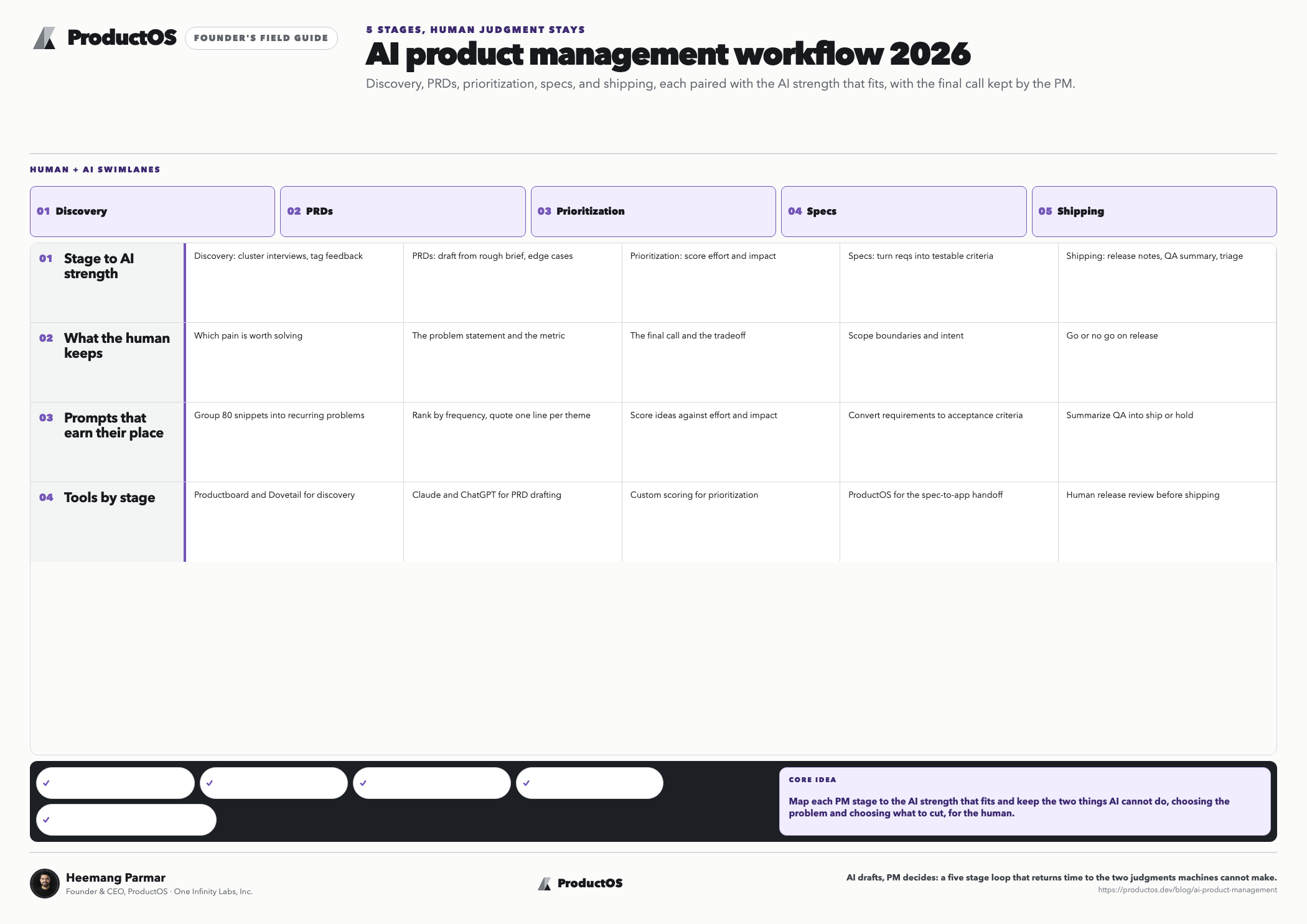
The AI product management workflow at a glance
Product management is really five different jobs, and each one rewards a different kind of AI. The tool that synthesizes 200 interviews is rarely the tool that writes a sharp PRD. Map the stage to the strength before you pick anything.
| Stage | What AI does well | What you still own |
|---|---|---|
| Discovery | Cluster interviews, tag feedback, surface themes | Which pain is worth solving |
| PRDs | Draft from a rough brief, generate edge cases | The problem statement and the metric |
| Prioritization | Score against effort and impact, spot conflicts | The final call and the tradeoff |
| Specs | Turn requirements into testable acceptance criteria | Scope boundaries and intent |
| Shipping | Draft release notes, summarize QA, triage bugs | Go or no-go |
The 5-stage AI product management workflow
Discovery: let AI read what you cannot. You have more customer signal than you can process, support tickets, sales calls, reviews, interview transcripts. Feed it to an AI to cluster and tag. A prompt as simple as “Group these 80 interview snippets into recurring problems, rank by frequency, and quote one verbatim line per theme” will surface patterns in minutes that used to take a synthesis workshop. Tools like Productboard and Dovetail now do this natively, but a plain LLM with a good prompt gets you 80% of the way. The trap: AI over-clusters and invents tidy themes that flatten real nuance, so always read the raw quotes behind each cluster before you believe it. For a fuller approach here, see AI market research.
PRDs: draft in seconds, then defend every line. This is where AI saves the most time and does the most damage. Give it your rough notes and a structure, and it hands back a full first draft, problem, users, requirements, edge cases, before your coffee is cold. But AI optimizes for looking complete, not being right. It will invent a plausible success metric and ten requirements you never asked for. Treat the draft as a strong intern’s first pass: you keep the single metric, the problem statement, and the scope line, and delete anything you cannot defend. The full format lives in the product requirements document guide.
Prioritization: use AI to argue, not to decide. Paste your backlog and ask the model to score each item on reach, impact, confidence, and effort, then to flag where items conflict or depend on each other. The value is not the score, it is being forced to make your reasoning explicit. AI is genuinely good at catching the dependency you missed and the two features that are secretly the same bet. It is bad at knowing which risk your business can afford this quarter. Tie the ranking back to your north star metric so the list ladders up to something real, then make the final call yourself.
Specs: turn intent into testable criteria. A requirement like “users can reset their password” is ambiguous, and ambiguity is where builds go wrong. Ask AI to rewrite each requirement as acceptance criteria in “Given, When, Then” form, then to list the edge cases you forgot: expired tokens, rate limits, empty states. This is the highest-leverage AI use in the whole workflow, because the output feeds directly into what gets built. In 2026 that increasingly means AI coding agents, not just human engineers, and agents resolve ambiguity for you, rarely the way you wanted. Platforms like ProductOS, an AI operating system for product development, carry that handoff further, taking a spec through design to a shipped web, mobile, or desktop app, which only raises the premium on getting the acceptance criteria right before the build starts.
Shipping: automate the connective tissue. The last mile is full of small writing tasks AI handles cleanly: draft release notes from the merged PRs, summarize a QA thread into a go or no-go recommendation, turn a bug report into a reproducible ticket, write the changelog and the internal announcement. None of these need judgment, all of them need doing, and batching them through AI reclaims hours every release. You still own the go decision. Everything around it can be drafted.
Which AI models to reach for in 2026
You do not need one model, you need the right one per task. The landscape as of mid-2026: Anthropic’s Claude family leads on writing quality and coding reliability, OpenAI’s GPT-5.5 ships as the ChatGPT default, and Google’s Gemini 3.1 Pro wins on long context and price-to-performance (source).
In practice: use a long-context model for discovery synthesis, where you are dumping hundreds of pages in at once. Use a strong-writing model for PRDs and specs, where phrasing carries meaning. Purpose-built tools like ChatPRD are trained on real product docs and understand PM context in ways a generic chat model does not, so they are worth trying for documentation specifically. Do not marry one vendor. The models leapfrog each other every few months, and the switching cost is low.
The one rule that keeps this from going wrong
AI is a force multiplier on whatever you feed it, including your bad thinking. If your problem statement is vague, AI will produce a confident, well-formatted, vague PRD, and its polish will fool you into shipping it. The teams getting real leverage are not the ones generating the most output. They are the ones using AI to move faster on the parts that do not need judgment, and slowing down on the parts that do. Own the problem, own the metric, own the scope. Let AI have the rest.
Frequently asked questions
What is AI product management?
It is running the standard product workflow, discovery, PRDs, prioritization, specs, and shipping, with AI handling the drafting, synthesis, and summarizing while the PM keeps the strategic decisions. AI removes the repetitive work, but it does not decide what to build or what matters. The judgment stays human.
Will AI replace product managers?
No, but it changes the job. AI automates the parts of PM work that are writing and synthesis, which is a large share of the week, and that raises the bar on the parts it cannot do: taste, prioritization, and knowing which problem is worth solving. PMs who use AI well will outpace those who do not, but the core judgment work is more valuable than ever.
What is the best AI tool for product managers?
There is no single best tool, because PM work is five different jobs. Discovery rewards synthesis tools like Dovetail or Productboard, documentation rewards purpose-built writers like ChatPRD, and prioritization rewards tools wired to your roadmap. Most PMs end up with a small stack plus a general chat model for everything else.
How do I stop AI from inventing fake requirements in a PRD?
Treat every AI draft as a first pass to edit down, not a finished document. Keep the problem statement, the single success metric, and the scope line under your own control, and delete any requirement you cannot defend out loud. The failure mode is AI optimizing for looking complete, so your job is cutting, not adding.
Do PRDs still matter if I build with AI coding agents?
They matter more. Coding agents turn ambiguity into code, usually not the code you wanted, so precise and testable requirements are now the difference between a clean build and a rework loop. In 2026 the PRD is the interface between your intent and the software an agent generates.
CS engineer and IIM Lucknow MBA. Built products across enterprise and AI for 10+ years. Founded ProductOS to give every PM and founder the leverage of a full product team. Writes about AI product development, PRDs, and building with agents.